
In my PR biz of publicizing mobile software developers, I discovered early on the high value of finding and developing relationships with bloggers who have a high-level interest in mobile tech. They're not journalists in the traditional sense, but the good ones have a niche following of people who would be a good audience for my clients.
Sometimes, the most popular blogs are really difficult to crack. They hear from PR people all the time -- and what makes me different than all those others? I need to do more than keep sending product news to them. I have to be a resource for them. I need to follow what they're interested in writing about, and engage them in dialogue about it even if it has absolutely nothing to do with any of my clients. If they response and find me a "wise ol' owl" who is fun and useful to talk to, I may have made a new friend in the blogger business and can become a trusted source.
How do you find good blogs? Start by searching your topic keyword(s) at Google Blog Search and Technorati. You may also want to add BlogPulse to that list for fun. Build a list of blogs, then look at each one to see if they have their own favorite blogs listed out for you!
Microblogs, such as Twitter, can be researched at TweetScan and Topsy. BlackBerry users can have Twitter hits on their keywords sent to their mobiles using an app called Twitterlerts.
If you want to follow what's being said about your company or brand in the social media sphere, try searching at SocialMention which will also pick up news from Twitter and blogs.
Showing posts with label Google. Show all posts
Showing posts with label Google. Show all posts
Monday, July 05, 2010

Wednesday, April 07, 2010
The need to SEO your press release
If you don't understand how to write a good SEOed press release, the result will be either a press release that isn’t optimized at all or one that’s over-optimized and difficult to read. Have you ever read a press release with too much emphasis on trying to impress search engines? Hello Mr. Press Release Writer! Your news still needs to be understood by PEOPLE! Don't obsess over cramming keywords in every paragraph of your press release. Instead, do research on which keywords are effective and use the effectively where it doesn't sacrifice readability. A good press release should be easy-to-read that also just happens to be optimized for search engines.
Google has a keyword tool that you can use to analyze your website to determine keywords that may attract the most attention.
Many newswires, such as PRWeb, will let you embed links back to your site -- and if they're well placed and turn keywords into anchor links that take the reader to relevant pages on your site, then your press release expands its ability to not only drive traffic to your site, but help educate readers by steering them to the right places for more information.
Google has a keyword tool that you can use to analyze your website to determine keywords that may attract the most attention.
Many newswires, such as PRWeb, will let you embed links back to your site -- and if they're well placed and turn keywords into anchor links that take the reader to relevant pages on your site, then your press release expands its ability to not only drive traffic to your site, but help educate readers by steering them to the right places for more information.
Thursday, April 01, 2010
Topeka This!
The ultimate kick-back for re-naming Topeka after Google for the month of March, Google renames itself Topeka for... (presumably April Fools Day?)
Well played gentlemen!
From Google's, er, I mean, Topeka's blog post this morning:

Well played gentlemen!
From Google's, er, I mean, Topeka's blog post this morning:
- As our lawyers remind us, branded product names can achieve such popularity as to risk losing their trademark status (see cellophane, zippers, trampolines, et al). So we hope all of you will do your best to remember our new name’s proper usage:

Tuesday, March 02, 2010
Google, Kansas
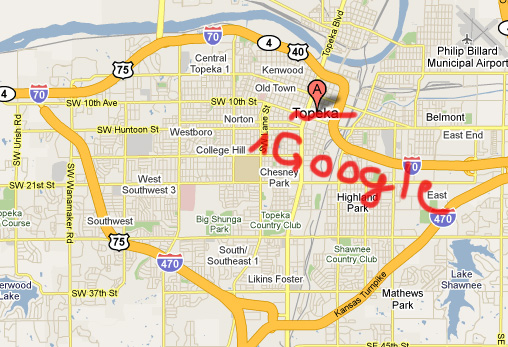 Over at my Kevin in the Kan blog, I've been writing about my hometown's efforts to woo Google to select it as a test site for its high-speed fiber optic network (which would bring surfing speeds of 100x faster than what most people have now).
I thought I would mention it here too because of how viral this grassroots effort has become. It is really a grand lesson in the power of social media and word of mouth (and how a community can work together WITH its government toward a common goal).
The latest PR move is when the mayor proclaimed that during the month of March, Topeka shall hereby be known as Google, Kansas. A silly move to attract Google's attention? Perhaps. That's what some are saying, but it's getting noticed! Here is some of the press attention Topeka (err...Google) has picked up:
CNBC
Wall Street Journal
BusinessWeek
CNN (I like this one a lot...good job Mayor Bunten)
Christian Science Monitor
San Jose Mercury
The Week
The Register (UK)
Seattle Post-Intelligencer
San Francisco Business Times
Washington Post
Computerworld/Networkworld
Kansas City Star
CNET
National Post
Associated Press
Examiner.com
Barron's
Connected Planet
Newser
Los Angeles Times
Digital Trends
VentureBeat
TMCnet
NBC Bay Area
TechCrunch
PC World
The local effort has been pretty much exclusively through Facebook and other social media, plus local get-togethers. Check out the ThinkBigTopeka site for more info on the campaign.
Tuesday, February 16, 2010
Doesn't Google Buzz just sound like a great PR thing?
I signed up for Google Buzz -- because what PR guy doesn't like anything that has the word "buzz" in it.
Buzz turns my Gmail into another social networking opportunity. Woo hoo! Just what I needed. Here it is in a nutshell:
* Automatic friends lists (friends are added automatically who you have emailed on Gmail)
* "Rich fast sharing" combines sources like Picasa and Twitter into a single feed, and it includes full-sized photo browsing
* Public and private sharing (swap between family and friends)
* Inbox integration (instead of emailing you with updates, like Facebook might, Buzz features emails that update dynamically with all Buzz thread content, like the photo viewer we mentioned above)
* "Recommended Buzz" puts friend-of-friend content into your stream, even if you're not acquainted. Recommendations learn over time with your feedback.
But, much to Google's chagrine, the "buzz" has been mostly bad. I've heard from several of my friends who have nixed it after a brief trial run.
This article highlights some of the most notable negatives:
Buzz seemed to have a mind of its own, picking names in your email inbox , and selecting them randomly for you to follow in your "Buzz" network.
"Thanks Google Buzz, I'm automatically following 3 ex-girlfriends. #fail," wrote Tony Pitluga of Pittsburgh in a tweet that was widely re-tweeted last week.
Another problem users discovered is that Google makes public everything you do in Buzz in its search engine, unless you set the privacy settings ahead of time.
Can Buzz bounce back? Google announced some improvements and should get credit for reacting quickly -- but as for me, I'll turn it off. I have Facebook, LinkedIn and Twitter, and that's enough social networking for me. Why add one more?
Buzz turns my Gmail into another social networking opportunity. Woo hoo! Just what I needed. Here it is in a nutshell:
* Automatic friends lists (friends are added automatically who you have emailed on Gmail)
* "Rich fast sharing" combines sources like Picasa and Twitter into a single feed, and it includes full-sized photo browsing
* Public and private sharing (swap between family and friends)
* Inbox integration (instead of emailing you with updates, like Facebook might, Buzz features emails that update dynamically with all Buzz thread content, like the photo viewer we mentioned above)
* "Recommended Buzz" puts friend-of-friend content into your stream, even if you're not acquainted. Recommendations learn over time with your feedback.
But, much to Google's chagrine, the "buzz" has been mostly bad. I've heard from several of my friends who have nixed it after a brief trial run.
This article highlights some of the most notable negatives:
Buzz seemed to have a mind of its own, picking names in your email inbox , and selecting them randomly for you to follow in your "Buzz" network.
"Thanks Google Buzz, I'm automatically following 3 ex-girlfriends. #fail," wrote Tony Pitluga of Pittsburgh in a tweet that was widely re-tweeted last week.
Another problem users discovered is that Google makes public everything you do in Buzz in its search engine, unless you set the privacy settings ahead of time.
Can Buzz bounce back? Google announced some improvements and should get credit for reacting quickly -- but as for me, I'll turn it off. I have Facebook, LinkedIn and Twitter, and that's enough social networking for me. Why add one more?
Monday, February 15, 2010
Don't be a pain in the Wave
I've been looking at Google Wave as a PR tool. Wave was introduced last year as a way to streamline communications into a single "wave" - it streams email, instant messaging, wikis, web chat, social networking, and project management into one platform.
What can you do on a wave? Your friends or colleagues can hold discussions, share files, chat, or comment on any of your post on any forum.
For PR pros, Wave changes the game. Anybody can contribute to the story with links, wikis, pictures, etc. BuzzMachine summarized it nicely here: "It combines the notions of a process as people add and subtract and update; it has the benefit of a wiki – a snapshot of current knowledge; it can be live; it can feed a blog page with the latest; it can feed Twitter with updates; it is itself the collaborative tool that lets participants question each other."
What I like is that Wave may return PR agents to communication agents versus just emailers of information. They can employ creative and engaging communication with anyone who joins the wave to get the word out about company news.
So leave it to PR people to already start getting a bad rap with a new technology tool. In my research, I found Jennifer Leggio's post highlighting some low-lights of how PR people have been violating the rules of engagement via social media:
1. Adding a journalist / blogger on Facebook and entering into a trusted network only to blatantly pitch said journalist / blogger on his or her “wall”
2. Spam @ messaging a journalist / blogger on Twitter multiple times to get them to review / write about your news or technology
3. Commenting on unrelated FriendFeed posts to try and get the writer’s attention
In a related post, Jason Perlow noted an early violation of Wave "PR Protocol" (if there's not such a thing, there soon will be). A pomegranate juice company I'd never heard of added him to their Wave -- you're not opted in, you're forced in.
Jason said: "As if using and trying to get used to Google Wave was bad enough, the PR agencies and marketing firms of the world have decided to start taking advantage of us, because we’re a captive audience and if they’ve ever contacted us in the past via e-mail on GMail, they now have a full contact database of people to torture by Google Wave if they were able to get an invite onto the system."
PR friends, Google Wave has a lot of potential for us, but let's respect the space of those influencers we want to connect with. Let's not be a pain in the wave and enlarge the credibility chasm our industry has with many in the media.
What can you do on a wave? Your friends or colleagues can hold discussions, share files, chat, or comment on any of your post on any forum.
For PR pros, Wave changes the game. Anybody can contribute to the story with links, wikis, pictures, etc. BuzzMachine summarized it nicely here: "It combines the notions of a process as people add and subtract and update; it has the benefit of a wiki – a snapshot of current knowledge; it can be live; it can feed a blog page with the latest; it can feed Twitter with updates; it is itself the collaborative tool that lets participants question each other."
What I like is that Wave may return PR agents to communication agents versus just emailers of information. They can employ creative and engaging communication with anyone who joins the wave to get the word out about company news.
So leave it to PR people to already start getting a bad rap with a new technology tool. In my research, I found Jennifer Leggio's post highlighting some low-lights of how PR people have been violating the rules of engagement via social media:
1. Adding a journalist / blogger on Facebook and entering into a trusted network only to blatantly pitch said journalist / blogger on his or her “wall”
2. Spam @ messaging a journalist / blogger on Twitter multiple times to get them to review / write about your news or technology
3. Commenting on unrelated FriendFeed posts to try and get the writer’s attention
In a related post, Jason Perlow noted an early violation of Wave "PR Protocol" (if there's not such a thing, there soon will be). A pomegranate juice company I'd never heard of added him to their Wave -- you're not opted in, you're forced in.
Jason said: "As if using and trying to get used to Google Wave was bad enough, the PR agencies and marketing firms of the world have decided to start taking advantage of us, because we’re a captive audience and if they’ve ever contacted us in the past via e-mail on GMail, they now have a full contact database of people to torture by Google Wave if they were able to get an invite onto the system."
PR friends, Google Wave has a lot of potential for us, but let's respect the space of those influencers we want to connect with. Let's not be a pain in the wave and enlarge the credibility chasm our industry has with many in the media.
Subscribe to:
Posts (Atom)