
Way back when I had just left the restaurant industry and got hired on with my first (and only) PR agency (that's not my own), I learned from the worst about media relations. My old boss got everything wrong when it came to developing relationships with the people who can make or break our efforts on behalf of clients. The line she used that really sticks with me is "Screw the media -- they don't pay us." Even a PR neophyte knew that was a stupid attitude, and only deepens the negative attitude many in the media have toward PR people.
I ignored the boss's advice. Within a year of starting that job, bigger agencies were calling me to set up interviews. How did they know anything about me? They asked journalists in Dallas who the best media relations people were and my name kept coming up. Some of those opportunities seemed pretty good, but I decided I'd rather enter the world of the gainfully self-employed. After all, if a complete nonsensical ninny could make a living at this business, I could reverse engineer everything she practiced and be more successful.
While my old agency had a revolving door of clients, often leaving after the first six months, I've got three clients that have been with me for 9-10 years now. Am I bragging? Ehhhh...maybe a little.
Back to media relations, I really enjoyed this article that compares media relations to dating.
#1 is my favorite:
1. The best pickup line is a basic introduction
Are your legs tired? You know, because you’ve been running through my mind since you walked into this place. That’s an example of a bad pickup line in dating circles. You know what the most effective pickup line is? Hello, my name is [insert your name].
The same goes for media relations. A fancy opening line, no matter how clever you think it is, will only result in a reporter rolling their eyes at you. Introduce yourself professionally, let them know who you are and why you’re calling and you’ll get things off on the right foot. Don’t use a cheesy pickup line when introducing yourself to a journalist.
One time I pitched a CNET reporter on an app called LobsterTunes in a manner that was probably too cute by half. But with an app called LobsterTunes, what's a PR guy to do? She called me on it and said she might have been more interested if I'd left off the cheesy intro. Now I leave the cheese for after I've gotten to know a journalist better and they can tell by the clever pitch that I've got my tongue planted firmly in my cheek. It's like the kind of jokes you can tell your old buddies that wouldn't have told them when you first met them.
That said, you don't want to come off as dry. You can be clever without being cheesy. I appreciate cleverness, but just make sure your pitch doesn't peg the cheese-meter.
Thursday, April 29, 2010

Wednesday, April 28, 2010
10 Dos and Don’ts for Brands on Twitter
From Mashable:
 Interesting tips for using Twitter to support, promote and defend your brand. Click to the post for the details on each, but here are the 10 headers...
1. Don't be a showoff
2. Use proper grammar and spelling
3. Don't get too personal
4. Don't auto-Tweet
5. Don't leave air in the conversation
6. Don't overtweet
7. Do shout out to those who tweet about you
8. Do monitor keywords and competitors
9. Do make an informative profile
10. Do fish where the fish are
To me, the most interesting AND most painful as a PR guy is #1: "Give Twitter users your features and benefits. Let them know about special deals. Don’t post links to your latest press release, promote articles written by your CEO or make extravagant claims. A good rule of thumb to determine whether a tweet is user-friendly or brand vanity is to ask yourself, “If I didn’t work here, would I care about this?” If you’re not sure, ask a brutally honest friend who doesn’t work at your company."
When I have a good press release, I want to at least link to it. There are journalists and bloggers that follow me. So what do we do? From #3: "Keep your conversations warm but professional; it’s what users expect from a brand ambassador, and anything else comes off as creepy."
Twitter is a place for conversations, not broadcasting. And if you're going to converse, who wants to converse with someone jargonizing in PR-speak? When I tweet announcements, I keep them casual and fun. I also like to use it for breaking or leaking the news. Twitter followers like getting exclusives! Who doesn't?
Monday, April 26, 2010
No more Ning
As I've mentioned before, I administer a couple of Ning social networks. The value proposition was that you could, for free, set-up your own social network. It's great for clubs, churches, networking associations, etc. to provide a Facebook-like experience for those who share a common affinity around the organization or interest.
This was the promise on which oodles of groups started their Ning networks and got people to sign up, upload pictures, blog posts, calendar items and all sorts of other content.
But now Ning is going to press the Delete key on your Ning if you don't pony up!
From their website:
"We recently made the decision to focus 100 percent of the company on enhancing the features and services we offer to paying Network Creators. As part of this change, we'll be phasing out our free service. We will announce further details about Ning's product roadmap and different pricing options on May 4, 2010."
I'm not naive enough to think that businesses don't need to re-think their business model from time-to-time, especially if you're not making money. But when you're entire business model has been based on a free social network, and you get people to spend hours of their time building and maintaining their Ning site, you shouldn't just hit Delete on them. It's a broken promise. I'm not here to tell Ning how to do their business (ok, I've done it before with the spam thing, so I might as well do it again) but it doesn't seem like a good thing to build your business on a promise and then back out on it. It's bait and switch, and the bait now smells pretty fishy. Sorry, terrible pun!
Tuesday, April 20, 2010
Judging books by their covers

The content of the book doesn't matter if the cover doesn't appeal to the target audience. Obviously book publishers have discovered young adults have an affinity for black.
Regardless of what "content" is in your "book" (the product you sell, if you're not getting the metaphor), is your cover designed to reach your target audience?
Now if I were publishing a popular book for young adults, and knowing that everyone else's book would hardly be distinguishable from each other, I'd make mine in red.
Wednesday, April 07, 2010
The need to SEO your press release
If you don't understand how to write a good SEOed press release, the result will be either a press release that isn’t optimized at all or one that’s over-optimized and difficult to read. Have you ever read a press release with too much emphasis on trying to impress search engines? Hello Mr. Press Release Writer! Your news still needs to be understood by PEOPLE! Don't obsess over cramming keywords in every paragraph of your press release. Instead, do research on which keywords are effective and use the effectively where it doesn't sacrifice readability. A good press release should be easy-to-read that also just happens to be optimized for search engines.
Google has a keyword tool that you can use to analyze your website to determine keywords that may attract the most attention.
Many newswires, such as PRWeb, will let you embed links back to your site -- and if they're well placed and turn keywords into anchor links that take the reader to relevant pages on your site, then your press release expands its ability to not only drive traffic to your site, but help educate readers by steering them to the right places for more information.
Tuesday, April 06, 2010
The value of public relations
Toronto-based MDC Partners has announced it has acquired a majority interest in Sloane & Company, a New York-based public relations firm. Miles Nadal, MDC chairman, has said he's willing to spend up to $100 million on agency and personnel acquisitions in the coming months! Hey Miles! Over here in Topeka is a great boutique agency specializing in the booming mobile app business!
Here's his quote that I'd like to splash around today:
"We believe that most of the innovative initiatives happening in marketing communications today are happening within the public relations arena," Nadal said in a statement. "Clients are under enormous pressure to deliver measurable results in a shorter and shorter time frame. Smaller entrepreneurial firms that are empowered to think differently, have the ability to do brilliant work and want to share the wealth, are the best partners for us."
For all of the negative flack the PR biz gets, especially from our friends in the media who have to put up with cold-pitches and poorly aimed emails from PR people who don't do their homework, it is true that the best results and the greatest innovation comes from within the PR disciplines. Engaging publics through social media is much more a function of the PR form of strategic communication than other forms of marketing communication.
Since I started Talon 12 years ago, it's amazing how many times I've had to reinvent what I do. With technology and consumer changes, the task of the PR force is to recognize how to leverage those new technologies to reach those new consumers and influence them favorably toward the organizations we represent.
This is what Winning Rules is all about. Let me know if you discover any of those "innovative initiatives" Nadal talks about so we can explore them together.
Thursday, April 01, 2010
Topeka This!
The ultimate kick-back for re-naming Topeka after Google for the month of March, Google renames itself Topeka for... (presumably April Fools Day?)
Well played gentlemen!
From Google's, er, I mean, Topeka's blog post this morning:

Well played gentlemen!
From Google's, er, I mean, Topeka's blog post this morning:
- As our lawyers remind us, branded product names can achieve such popularity as to risk losing their trademark status (see cellophane, zippers, trampolines, et al). So we hope all of you will do your best to remember our new name’s proper usage:

Monday, March 29, 2010
Getting Insight into Facebook
I serve as Admin over several Facebook Fan Pages -- one for my business, one for my church, and a few for clients. Lately I've been getting emails from Facebook reporting on how much traffic and other activity each Page gets:
After each item, it gives you the comparable number from the previous week. Thank you Facebook! I love it.
Another tool that is often overlooked is Facebook Insights. For a Page Admin, you'll find it in the left column of your page. Under Insights, click on See All to get more detailed reports on your page's activity.
From the Facebook Help definition, "Facebook Insights measures user exposure, actions, and behavior relating to your Social Ads and Facebook Page. By understanding activity and performance, fans and ad respondents, and trends and comparisons, you are better equipped to improve your business on Facebook and elsewhere. Insights is a free service for all Facebook Pages and Social Ads."
I recently read that there are more than 1.4M Facebook Pages, including 700,000 small businesses. There are just too many users to ignore unless you're convinced that your audience isn't on Facebook for some reason. But even if you think your audience is too old for Facebook, I just checked the Insights for my church Facebook page and for a church that is trending younger (certainly under 50), 34% are over 45 and 16% are over 55.
The useful data that Facebook provides lets you know whether you or being effective in reaching your target audience with your Page and any ads that point to it. Don't ignore this information!
- Fans this week
- Wall Posts, Comments, and Likes this week
- Visits to your page this week
After each item, it gives you the comparable number from the previous week. Thank you Facebook! I love it.
Another tool that is often overlooked is Facebook Insights. For a Page Admin, you'll find it in the left column of your page. Under Insights, click on See All to get more detailed reports on your page's activity.
From the Facebook Help definition, "Facebook Insights measures user exposure, actions, and behavior relating to your Social Ads and Facebook Page. By understanding activity and performance, fans and ad respondents, and trends and comparisons, you are better equipped to improve your business on Facebook and elsewhere. Insights is a free service for all Facebook Pages and Social Ads."
I recently read that there are more than 1.4M Facebook Pages, including 700,000 small businesses. There are just too many users to ignore unless you're convinced that your audience isn't on Facebook for some reason. But even if you think your audience is too old for Facebook, I just checked the Insights for my church Facebook page and for a church that is trending younger (certainly under 50), 34% are over 45 and 16% are over 55.
The useful data that Facebook provides lets you know whether you or being effective in reaching your target audience with your Page and any ads that point to it. Don't ignore this information!
Thursday, March 25, 2010
Annoying Ning
I administer a couple different Ning social networks (which is a create-your-own network service). Ning offers nice features for groups to have their own social networking, such as pictures, video, blogs, chat, etc.
BUT BEWARE!
Anyone who is a member of your Ning can submit blog posts. You can control which ones get published if you're the admin, but it doesn't stop spammers from auto-sending loads of crap. I had to create a rule in my Outlook inbox that if the subject line says I "have a Ning blog post to approve" the email automatically goes to my junk folder. That folder had received about 60 of those emails today!
When I checked my Ning, I had 150+ first name members with gmail addresses. I deleted them all and reported them for spam, then changed my settings so that I have to approve all new members.
Ning needs to give the admin the ability to limit who can post to the blogs. I looked and there's only an option to moderate posts or not.
Wednesday, March 24, 2010
SEOing Press Releases
I've been a customer of PRWeb for years -- back when I first met the founder in his tiny Dallas office and tried to talk him into letting me do his PR. Back then, he didn't have a budget and I didn't have a clue. I remember he had one small server on the floor of his office. Now David is no longer with the company -- it was purchased by Vocus a few years ago.
PRWeb does a really good job, I think, of helping you to create press releases that are search engine optimized. You build-in hyperlinks, categorize your news, insert keywords (or at least you did...recently I haven't spotted that field) and pictures, and can change the name of the URL to include 2 keywords that might help to attract more search engine attention.
Regardless of the wire service you use, if any, your press releases should be written with search engines in mind. Most of the time, your news will be read online.
Benefits of an SEOed press release include:
In fact, check out our MobilityNewswire website. This site pulls in our PRWeb RSS feeds from press releases we set up for our mobile software development clients.
PRWeb does a really good job, I think, of helping you to create press releases that are search engine optimized. You build-in hyperlinks, categorize your news, insert keywords (or at least you did...recently I haven't spotted that field) and pictures, and can change the name of the URL to include 2 keywords that might help to attract more search engine attention.
Regardless of the wire service you use, if any, your press releases should be written with search engines in mind. Most of the time, your news will be read online.
Benefits of an SEOed press release include:
- Improved search engine ranking
- Publicity in online media
- Increased website traffic
- Leads and sales!
In fact, check out our MobilityNewswire website. This site pulls in our PRWeb RSS feeds from press releases we set up for our mobile software development clients.
Friday, March 19, 2010
Pay to Play Journalism
A CNET writer that I work with from time to time sent me a link to a Wired article on the topic of "pay to play" review sites. The sites mentioned in the article, AppCraver and TheIphoneAppReview, both have sent me replies when I've pitched apps to them for review that I could get my app reviewed or expedited for a fee. This practice of editorial for a fee is common in mainstream media in other countries, but in the US we like to think that there is a firm line between editorial and advertising coverage.
I don't pay for reviews or any other kind of coverage because the practice is damaging to the credibility of the editorial review process which makes PR so much more, well, credible, than display advertising. The benefits of PR is that the perceived value of the information is so much higher because of the implied 3rd party endorsement of the journalist who is not compensated by the subject of the article. Simply put, rewarding this kind of media with revenue to get them to write a review will encourage this kind of "advertorial" business to flourish and, as a result, water down the advantage my service offers over other types of marketing communications.
Especially egregious is when these reviews don't disclose that they've been compensated for the article so the reader can judge for themselves whether or not the writing was biased in favor of the subject.
The line between advertising and editorial is one that gets blurred now in every form of media. Until recently, I published my city's business magazine and of course those who spent money advertising in the magazine wanted to be our quoted experts in the feature articles.
So how is a website or other form of media supposed to generate revenue? I personally think having ads and editorial that happen to feature the same companies just isn't the same kind of crime as making them pay for editorial coverage. Sure, all things being equal, if someone I worked with as an advertiser in the magazine happened to be a great source for an article, I saw no harm in quoting them because I knew them and their expertise couldn't be questioned just because they also placed a display ad somewhere in the magazine.
But the "pay to play" practice where payment for editorial coverage is required is bad for my business and the journalism business because it reduces the credibility of both. Everyone knows that websites and other media are supported by advertising, so the media company should clearly state its policy on the line between journalism and advertising and let the consumer judge the veracity of their content.
Wednesday, March 17, 2010
The End of Publishing?
Check out this very clever video that demonstrates how much we may be misunderstanding the upcoming generation and how it speaks to the publishing industry in the era of the Nook, Kindle and iPad.
Friday, March 12, 2010
Getting noticed on the web
I've spent a bit of time over the past few days looking at church websites. Man, they're bad! Of course, that's why there's a website called Church Marketing Sucks! As the communication team leader at my church (charged with internal and external publicity), I want our church website to look good, offer usable content, and be easily found by people looking for a church home. Unfortunately, our website comes with a subscription-based church management system that offers a really grand "behind the curtain" online community for members -- and while better than most church websites, ours still sucks.
We're going to take matters into our own hands and develop our own website that looks much better, is written for the web, and is search engine optimized.
When you put together a great looking website, how do you get people to find it? If you're looking for local traffic, you can advertise it to your local market in the newspaper, on Facebook or Google, or on radio or TV (if that makes sense to your kind of business). Don't forget the obvious: put it on your business cards, stationery and brochures!
There are important steps you need to take that will pay off in much bigger results for building your web traffic. Include target keywords and phrases that your prospects would be using to find you online. If you don't overwhelm your pages with meaningless words, the prominent use of keywords will make the page more appealing to the search engines and more meaningful to potential customers.
Carefully evaluate the benefits of online advertising (banners and pay-per-click). The nice thing is you can tell pretty easily if your investment is paying off and then adjust your budget to those ads that get the best results.
And use a blog and social media (Twitter and Facebook are no-brainers for many kinds of businesses) to connect with and keep in touch with customers -- and remind them about you and your website.
Tuesday, March 02, 2010
Google, Kansas
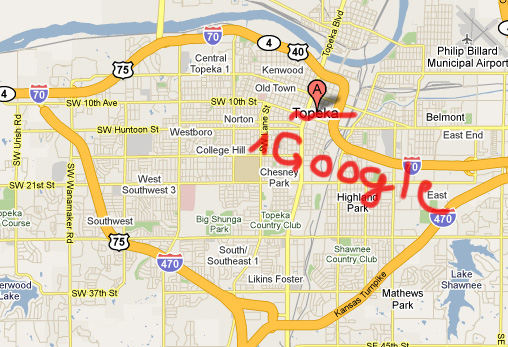 Over at my Kevin in the Kan blog, I've been writing about my hometown's efforts to woo Google to select it as a test site for its high-speed fiber optic network (which would bring surfing speeds of 100x faster than what most people have now).
I thought I would mention it here too because of how viral this grassroots effort has become. It is really a grand lesson in the power of social media and word of mouth (and how a community can work together WITH its government toward a common goal).
The latest PR move is when the mayor proclaimed that during the month of March, Topeka shall hereby be known as Google, Kansas. A silly move to attract Google's attention? Perhaps. That's what some are saying, but it's getting noticed! Here is some of the press attention Topeka (err...Google) has picked up:
CNBC
Wall Street Journal
BusinessWeek
CNN (I like this one a lot...good job Mayor Bunten)
Christian Science Monitor
San Jose Mercury
The Week
The Register (UK)
Seattle Post-Intelligencer
San Francisco Business Times
Washington Post
Computerworld/Networkworld
Kansas City Star
CNET
National Post
Associated Press
Examiner.com
Barron's
Connected Planet
Newser
Los Angeles Times
Digital Trends
VentureBeat
TMCnet
NBC Bay Area
TechCrunch
PC World
The local effort has been pretty much exclusively through Facebook and other social media, plus local get-togethers. Check out the ThinkBigTopeka site for more info on the campaign.
Friday, February 26, 2010
Funny video
Enjoy this video of a dialogue between a hapless PR fellow and a blogger who covers social media, just not B2B. So funny.
If you're offended by the F-word, it is used frequently. I stopped using it as part of my day-to-day vocabulary when I was 17, and don't normally like to hear it in a professional setting especially. But, ok, it's kind of funny in this case.
If you're offended by the F-word, it is used frequently. I stopped using it as part of my day-to-day vocabulary when I was 17, and don't normally like to hear it in a professional setting especially. But, ok, it's kind of funny in this case.
Wednesday, February 24, 2010
Increasing Twitter Followers
When it comes to social media, everything has its place:
Facebook is MOSTLY for my personal friends, acquaintances, and a bunch of people that I know somewhat. In retrospect, I wish I would have limited it only to people that I really know, instead of the 450+ people that I'm sure I've met at some point.
LinkedIn is where I prefer to network professionally, and I have this blog connected to it so that anyone following me on LinkedIn can easily see my thoughts on any given day. I've joined a number of business groups on LinkedIn and have made some good connections there.
Twitter is the odd one I was never sure what to do with. I'm not one of those who wants to tweet when I go to the bathroom or have a bologna sandwich, or how cool so-and-so was on such-and-such awards show last night. I pretty much use it to tweet about successful media placements for my PR clients so that more people can discover how awesome they are, and of course that will hopefully make me look like a good PR guy that others will want to use. In order for that approach to be a success, I need followers!
To increase the number of followers, I've been finding people who tweet about topics I tweet about -- mobile technology -- and begin following them. I often get followed back, and people discover me on those Twitter pages and begin following me because they too like learning about mobile apps.
I have heard that around 30% of the people you follow will follow you back.
I just downloaded something new to help me greatly expand my number of followers. It's called Twitter Adder, and it is supposed to help me manage Twitter followers, auto follow, and auto unfollow. I'll let you know how it goes!
Tuesday, February 16, 2010
Doesn't Google Buzz just sound like a great PR thing?
I signed up for Google Buzz -- because what PR guy doesn't like anything that has the word "buzz" in it.
Buzz turns my Gmail into another social networking opportunity. Woo hoo! Just what I needed. Here it is in a nutshell:
* Automatic friends lists (friends are added automatically who you have emailed on Gmail)
* "Rich fast sharing" combines sources like Picasa and Twitter into a single feed, and it includes full-sized photo browsing
* Public and private sharing (swap between family and friends)
* Inbox integration (instead of emailing you with updates, like Facebook might, Buzz features emails that update dynamically with all Buzz thread content, like the photo viewer we mentioned above)
* "Recommended Buzz" puts friend-of-friend content into your stream, even if you're not acquainted. Recommendations learn over time with your feedback.
But, much to Google's chagrine, the "buzz" has been mostly bad. I've heard from several of my friends who have nixed it after a brief trial run.
This article highlights some of the most notable negatives:
Buzz seemed to have a mind of its own, picking names in your email inbox , and selecting them randomly for you to follow in your "Buzz" network.
"Thanks Google Buzz, I'm automatically following 3 ex-girlfriends. #fail," wrote Tony Pitluga of Pittsburgh in a tweet that was widely re-tweeted last week.
Another problem users discovered is that Google makes public everything you do in Buzz in its search engine, unless you set the privacy settings ahead of time.
Can Buzz bounce back? Google announced some improvements and should get credit for reacting quickly -- but as for me, I'll turn it off. I have Facebook, LinkedIn and Twitter, and that's enough social networking for me. Why add one more?
Monday, February 15, 2010
Don't be a pain in the Wave
I've been looking at Google Wave as a PR tool. Wave was introduced last year as a way to streamline communications into a single "wave" - it streams email, instant messaging, wikis, web chat, social networking, and project management into one platform.
What can you do on a wave? Your friends or colleagues can hold discussions, share files, chat, or comment on any of your post on any forum.
For PR pros, Wave changes the game. Anybody can contribute to the story with links, wikis, pictures, etc. BuzzMachine summarized it nicely here: "It combines the notions of a process as people add and subtract and update; it has the benefit of a wiki – a snapshot of current knowledge; it can be live; it can feed a blog page with the latest; it can feed Twitter with updates; it is itself the collaborative tool that lets participants question each other."
What I like is that Wave may return PR agents to communication agents versus just emailers of information. They can employ creative and engaging communication with anyone who joins the wave to get the word out about company news.
So leave it to PR people to already start getting a bad rap with a new technology tool. In my research, I found Jennifer Leggio's post highlighting some low-lights of how PR people have been violating the rules of engagement via social media:
1. Adding a journalist / blogger on Facebook and entering into a trusted network only to blatantly pitch said journalist / blogger on his or her “wall”
2. Spam @ messaging a journalist / blogger on Twitter multiple times to get them to review / write about your news or technology
3. Commenting on unrelated FriendFeed posts to try and get the writer’s attention
In a related post, Jason Perlow noted an early violation of Wave "PR Protocol" (if there's not such a thing, there soon will be). A pomegranate juice company I'd never heard of added him to their Wave -- you're not opted in, you're forced in.
Jason said: "As if using and trying to get used to Google Wave was bad enough, the PR agencies and marketing firms of the world have decided to start taking advantage of us, because we’re a captive audience and if they’ve ever contacted us in the past via e-mail on GMail, they now have a full contact database of people to torture by Google Wave if they were able to get an invite onto the system."
PR friends, Google Wave has a lot of potential for us, but let's respect the space of those influencers we want to connect with. Let's not be a pain in the wave and enlarge the credibility chasm our industry has with many in the media.
Saturday, February 13, 2010
I'm back
Wow...I really ignored the Winning Rules blog didn't I? Since I last posted, I published 2 more years of TK Magazine and just recently divested myself from the magazine publishing business. I still own and operate The Business Center, which is Topeka's executive suites and virtual officing center.
But my true loves and main interests (in biz anyway) are still TalonPR and Talon Communications Group; the former offers public relations and social media support for mobile software developers while the latter offers graphic design, web marketing and public relations for any kind of business or non-profit.
I've been doing my personal blogging over at KevinintheKan.com, where I dump whatever random thoughts that cross my mind on the ills of our country and my state.
Back to WinningRules, though, I want to return to highlighting the "Winning Rules" and best practices of Web communications and marketing. There's already good blogs out there that cover it, of course, but hey, this is what I know so hopefully you'll find practical info here you can use in your own business.
Subscribe to this feed and please share your own thoughts.
Wednesday, July 18, 2007
Breaking News Backstab
Jonathan Zaleski, the director of The PR Collective, a nationwide consortium of boutique PR agencies (to which I belong) has started a new blog called SpinisIn. It's all about the "PR lifestyle."
I particularly enjoyed his entry entitled the Breaking News Backstab, about the times in which his big PR events were eradicated by breaking news stories, such as the Pope dying right before his big event at Dodger stadium. Give it a read and enjoy.
I particularly enjoyed his entry entitled the Breaking News Backstab, about the times in which his big PR events were eradicated by breaking news stories, such as the Pope dying right before his big event at Dodger stadium. Give it a read and enjoy.
Subscribe to:
Posts (Atom)