Thursday, June 24, 2010

No To Arts District - Dot Com

I'm watching the 10:00 news the other night with my wife and there's a story on an effort to turn Topeka's somewhat dilapidated yet promising North Topeka business area into a cool arts district. I'm all for that! It's like it's own little downtown and I love the entrepreneurship of North Topeka, and I think those old buildings would lend themselves nicely to an artsy area.

The news announcer told us of their website, www.notoartsdistrict.com, and pronounced it NoTo (sounds like Toto) Arts District - Dot Com. My wife looks up from her laptop and sees it spelled out on the screen and says "no to Arts district?"

Chalk this one up to another really unfortunate choice of a URL. Yes, a campaign for something that, if read the way it is spelled, sounds as if it is against it.

Which reminds me of an old email I received a long time ago featuring really bad website names. I know it's getting ever more difficult to find good domain names -- trust me, I have to do this pretty often -- but SERIOUSLY folks, if you think it could have a double meaning that would make you and your organization look foolish, don't go there! 

Here's the list:

1. "Who Represents" is where you can find the name of the agent that represents any celebrity. Their Web site is www.whorepresents.com
2 . Experts Exchange is a knowledge base where programmers can exchange advice and views at www.expertsexchange.com
3. Looking for a pen? Look no further than Pen Island at www.penisland.net
4. Need a therapist? Try Therapist Finder at www.therapistfinder.com
5. There's the Italian Power Generator company, www.powergenitalia.com
6. And don't forget the Mole Station Native Nursery in New South Wales ,
www ...molestationnursery.com
7. If you're looking for IP computer software, there's always
www.ipanywhere.com
8. The First Cumming Methodist Church Web site is www.cummingfirst.com
9. And the designers at Speed of Art await you at their wacky Web site,
www.speedofart.com

Tuesday, June 22, 2010

Shortening Long Links for Twitter Posts

You want to tweet a link to a great article about Apple's new iOS 4, or a great app that you like, but out of 140 characters, the link itself takes up 100 of them. What do you do?

Let's say your tweetable link is http://www.pcworld.com/businesscenter/article/198758/goodreader_for_ipad_adds_vga_output_performance_boost.html.

Go to http://bit.ly/ and enter that URL in the URL Shortener, then click on "Shorten." The URL is shortened to http://bit.ly/dbhD2z.

Then when you hover over that shortened URL, it gives you the option to copy it to your clipboard, which you can then paste into your Twitter post.

Thursday, June 17, 2010

A Big BP Person Caring for the Small People

As if the oil spill hasn't been the biggest PR disaster any company has ever suffered, I saw on the news last night that the company’s chairman, Carl-Henric Svanberg, said: “People say that large oil companies don’t care about the small people. But we care. We care about the small people.”

Speaking as one such small person, "Wow, are you kidding me?"


The company's PR people, poor damned souls as they are, jumped out of the lake of fire they currently find themselves in long enough to blame it on a clumsy translation. I don't care if he's a Swede or not, "small people" is a universal term used by snobby elitists worldwide.

I imagine a sliver of their problem is that Brits and Swedes are communicating to  people they have absolutely nothing in common with -- the small people of southern US. That's a huge communication gap to overcome. Then again, from what I've seen of response to the president's speech the other night about the matter, he and his plan for a panel and to "make them pay" didn't fare much better. They just want action down there. Spare us the panels and recriminations until AFTER the problem has been solved.

Monday, June 14, 2010

Fast websites rank higher among customers, Google

One thing I've always recognized is the impatience of net surfers. I know it because I am one -- and have become even more impatient as the years and technology advances has brought us ever-faster loading times. What I used to tolerate in terms of page loading now will cause me to move on to another site if the one I aimed at is just a wee bit too slow to load.

I'm not alone. Here's a good read on the topic. In this article, it refers to an experiment conducted by Google in which they slowed down the delivery of search results. They found that increasing a page's loading time by less than half a second has a measurably negative impact on searchers. And, the author found, "the customer is highly, highly impatient. They scan a page like they scan a signpost as they're driving down a motorway. They hardly even read full sentences."

Which is why marketers who write the copy for their websites like they do an informational brochure -- heavy with graphics and large blocks of text -- are missing the opportunity. To take the article's author's metaphor a step further, it's like the highway department putting the "how to merge" section of the driver's manual on the sign next to the highway instead of the recognizable symbol for doing the same thing.

Saturday, June 12, 2010

Fresh look at Perception Management

My wife and I just had to run over to the church to do some promotional set-up for our VBS registration table. I was walking through the darkened halls and looked up at a wall-mounted brochure rack. For the first time I noticed the words on the sign above it: "Information to Educate." Really? It just looks like brochures to me, and I GUESS that's the point of brochures, right? To educate?

But what a dorky way to say it.

Which made me think what would happen if I were able to take my old-timer blinders off and see the place fresh for the first time. What would I REALLY see, and would I be impressed or not?

It's hard to see things through the eyes of a visitor, or in the case of a business, your customer. You see the same place so often that the signs on the walls and the rust on the railings just becomes part of the landscape.

Get a notepad out and just try to see things as if you'd never seen them before. Secret shop your own place and see what you discover. If you find it an impossible task, for some reason, ask an outsider to do the same thing.

We don't want to miss the obvious and glaring signs and dirt and grime and cobwebs and bad service that outsiders will notice and forever impact their perceptions.

Sunday, May 23, 2010

Writing for the Web

I'm often asked what distinguishes our web site design services from others. While I see some beautifully designed sites out there, they are usually designed by, well, designers. The copy on the site is usually provided to them by the client and is often the same kind of marketing material that would go in their printed brochures. My answer to them is that our web sites are written for the web, and we follow rules to make sure the site accomplishes its objectives in terms how people read a website and how search engines scan them.

The first thing you need to know is that online readers want their information quick -- they've trained themselves to scan pages for the content they're looking for. They pop from site to site and don't have the patience for reading long paragraphs of text on your site.

Your copy must be both written and organized in such a way to get the readers' attention fast and directing them to the information they want and will help them navigate your site easily.

Keep your sentences and paragraphs as brief as possible. Use headers to help the readers scan, and make them clever enough to compel them to read that section.Put some useful links in the body of your article that can help your reader find both the information they want or the product they want to buy. Like any convenience store, signs and good organization can help people have a rewarding experience -- and get them in and out of there as quickly as they'd like, while lingering long enough to do business with you.

If you link to outside pages, make sure those links open up another window so they're not actually leaving your site! Why on earth would you link somewhere else? Like I mentioned earlier, people are scanners and they want to find useful information. If your site is found to be a resource for useful information -- even if it lies outside the boundaries of your own site -- then people will come back to it.


And, lastly, look for the keywords you know your customers are searching for and be sure they are included a number of times in the body of the text, in headers and in meta tags.

One of the sites I wrote that I think works well is not one we designed at all. Check out www.ringomo.com. Not to brag or anything, but I really like the short bursts of useful text, interesting headers, and good use of links to direct you where you want to go for the right information.

Tuesday, May 18, 2010

Church Marketing

I'm charged with "communications" at our church -- which entails both internal and external marketing. It's the most fun you can have in ministry, until you have to come up with a new logo that somehow encapsulates and represents both the old-time religion folks and the Millennials who don't care much about the institution of "church" but just want to get busy helping people.

This video has been around for awhile, but I watched it again last night and I just have to laugh every time I see it.


I've never understood how the collective Christian church, representing the Person who without a doubt was the greatest communicator who ever walked the planet, could be so lousy at communicating. Church Marketing Sucks! Which is, of course, why there is a great website by that very name!

Because of the new logo project I've been undertaking, I've searched the web to see what other churches have done with their logos and websites. Ugly stuff, let me tell you! Like any organization, a logo needs to reflect the organization's purpose and culture rather than being contrary to it. If the logos and websites I witnessed are reflective of their respective churches, then I would expect the churches to be very cookie-cutterish, emotionless, and unimaginative.

There were, however, some gems out there. Here are some of the churches that I think really stood out for their attractive websites and logos:

Calvary Church
Grace Community Church
Kingsfield Church
Stonebriar Community Church
The Crossings

Friday, May 07, 2010

A Touch of Luck?

I was on the treadmill this morning and looked up to the TV screen on the wall of the gym in time to see an ESPN replay of a PGA golfer chipping out of a sand trap. The ball delicately dropped a few feet short of the hole and rolled forward until -- PLUNK -- a miracle shot worthy of an ESPN highlight.

I don't know who the golfer was, but he's obviously talented enough to use his sand wedge to make such a great shot -- but not talented enough to avoid the bunker in the first place. His shot was both skill and luck. Sometimes it takes a good mix of both to be successful. If it was pure skill, pro golfers would never be in the bunker, and every tough shot would end up in the hole. Skill gets them close, but luck takes them the rest of the way.

When I'm launching a new app for, say, the iPad, the techniques may be similar as I'm reaching out to many of the same writers. Some of these campaigns are crazy successful (check out GoodReader -- STILL the #2 best-selling iPad app in the iTunes App Store after several weeks) while other campaigns are successful but maybe not what I'd hoped (boffo!). The difference may be timing, message, or the product itself, but some of it is just the level of luck -- hitting the right shot with the wind just-so and a squirrel that brushes the ball with his fluffy tail to cause the ball to drop in the hole.

We can't count on luck, so we must learn and practice the best techniques to get us as close to the cup as we can get (and perhaps a dash of luck will give us a highlight of our own).

Thursday, May 06, 2010

Advertising in the good times and bad

There's nothing like impeccable timing to start a business. I launched TK Magazine, for example, almost 4 years ago, and 1 year into it the economy began to fall apart. It's been a rough few years, mostly because the magazine is advertiser supported and companies slooooowed their advertising down or stopped it altogether.

There's the old story of Post vs Kelloggs from the days of the Great Depression. When the economy crashed and burned, Post pulled the reins on its advertising to save cash, while Kelloggs continued advertising -- realizing that it needed to continue pushing its message out there to the market. Going into the Great Depression, Kelloggs and Post each owned about the same percentage of the overall cereal market, but after the recovery, Kelloggs was so far out in front that to this day Post is still a Kelloggs wannabe.

It's been a BIT easier to sell ads as of late, but I admire those small business owners who realized that if they disappeared during the bad times, customers would be drawn to competitors who didn't and they may not be able to win them back during the good times.

“The man who stops advertising to save money is like the man who stops the clock to save time.” –Thomas Jefferson


Thursday, April 29, 2010

Masterful Media Relations

Way back when I had just left the restaurant industry and got hired on with my first (and only) PR agency (that's not my own), I learned from the worst about media relations. My old boss got everything wrong when it came to developing relationships with the people who can make or break our efforts on behalf of clients. The line she used that really sticks with me is "Screw the media -- they don't pay us." Even a PR neophyte knew that was a stupid attitude, and only deepens the negative attitude many in the media have toward PR people.

I ignored the boss's advice. Within a year of starting that job, bigger agencies were calling me to set up interviews. How did they know anything about me? They asked journalists in Dallas who the best media relations people were and my name kept coming up. Some of those opportunities seemed pretty good, but I decided I'd rather enter the world of the gainfully self-employed. After all, if a complete nonsensical ninny could make a living at this business, I could reverse engineer everything she practiced and be more successful.

While my old agency had a revolving door of clients, often leaving after the first six months, I've got three clients that have been with me for 9-10 years now. Am I bragging? Ehhhh...maybe a little.

Back to media relations, I really enjoyed this article that compares media relations to dating.

#1 is my favorite:
1. The best pickup line is a basic introduction
Are your legs tired? You know, because you’ve been running through my mind since you walked into this place. That’s an example of a bad pickup line in dating circles. You know what the most effective pickup line is? Hello, my name is [insert your name].
The same goes for media relations. A fancy opening line, no matter how clever you think it is, will only result in a reporter rolling their eyes at you. Introduce yourself professionally, let them know who you are and why you’re calling and you’ll get things off on the right foot. Don’t use a cheesy pickup line when introducing yourself to a journalist.

One time I pitched a CNET reporter on an app called LobsterTunes in a manner that was probably too cute by half. But with an app called LobsterTunes, what's a PR guy to do? She called me on it and said she might have been more interested if I'd left off the cheesy intro. Now I leave the cheese for after I've gotten to know a journalist better and they can tell by the clever pitch that I've got my tongue planted firmly in my cheek. It's like the kind of jokes you can tell your old buddies that wouldn't have told them when you first met them.

That said, you don't want to come off as dry. You can be clever without being cheesy. I appreciate cleverness, but just make sure your pitch doesn't peg the cheese-meter.

Wednesday, April 28, 2010

10 Dos and Don’ts for Brands on Twitter

From Mashable:

Interesting tips for using Twitter to support, promote and defend your brand. Click to the post for the details on each, but here are the 10 headers...

1. Don't be a showoff
2. Use proper grammar and spelling
3. Don't get too personal
4. Don't auto-Tweet
5. Don't leave air in the conversation
6. Don't overtweet
7. Do shout out to those who tweet about you
8. Do monitor keywords and competitors
9. Do make an informative profile
10. Do fish where the fish are

To me, the most interesting AND most painful as a PR guy is #1: "Give Twitter users your features and benefits. Let them know about special deals. Don’t post links to your latest press release, promote articles written by your CEO or make extravagant claims. A good rule of thumb to determine whether a tweet is user-friendly or brand vanity is to ask yourself, “If I didn’t work here, would I care about this?” If you’re not sure, ask a brutally honest friend who doesn’t work at your company."

When I have a good press release, I want to at least link to it. There are journalists and bloggers that follow me. So what do we do? From #3: "Keep your conversations warm but professional; it’s what users expect from a brand ambassador, and anything else comes off as creepy."

Twitter is a place for conversations, not broadcasting. And if you're going to converse, who wants to converse with someone jargonizing in PR-speak? When I tweet announcements, I keep them casual and fun. I also like to use it for breaking or leaking the news. Twitter followers like getting exclusives! Who doesn't?

Monday, April 26, 2010

No more Ning

As I've mentioned before, I administer a couple of Ning social networks. The value proposition was that you could, for free, set-up your own social network. It's great for clubs, churches, networking associations, etc. to provide a Facebook-like experience for those who share a common affinity around the organization or interest.

This was the promise on which oodles of groups started their Ning networks and got people to sign up, upload pictures, blog posts, calendar items and all sorts of other content.

But now Ning is going to press the Delete key on your Ning if you don't pony up!

From their website:

"We recently made the decision to focus 100 percent of the company on enhancing the features and services we offer to paying Network Creators. As part of this change, we'll be phasing out our free service. We will announce further details about Ning's product roadmap and different pricing options on May 4, 2010."

I'm not naive enough to think that businesses don't need to re-think their business model from time-to-time, especially if you're not making money. But when you're entire business model has been based on a free social network, and you get people to spend hours of their time building and maintaining their Ning site, you shouldn't just hit Delete on them. It's a broken promise. I'm not here to tell Ning how to do their business (ok, I've done it before with the spam thing, so I might as well do it again) but it doesn't seem like a good thing to build your business on a promise and then back out on it. It's bait and switch, and the bait now smells pretty fishy.  Sorry, terrible pun!

Tuesday, April 20, 2010

Judging books by their covers

I was perusing the bookshelves of Target the other night and wandered past the "Young Adult" section. "Did the lights go out?" I ask myself. No, it's just that pretty much every book for teens and "young adults" are black. I know they're into vampires big time, and you can't really have a happy, cheerful color on the covers of books about vampires -- but not all those books are about vampires.

The content of the book doesn't matter if the cover doesn't appeal to the target audience. Obviously book publishers have discovered young adults have an affinity for black.

Regardless of what "content" is in your "book" (the product you sell, if you're not getting the metaphor), is your cover designed to reach your target audience?

Now if I were publishing a popular book for young adults, and knowing that everyone else's book would hardly be distinguishable from each other, I'd make mine in red.

Wednesday, April 07, 2010

The need to SEO your press release

If you don't understand how to write a good SEOed press release, the result will be either a press release that isn’t optimized at all or one that’s over-optimized and difficult to read. Have you ever read a press release with too much emphasis on trying to impress search engines? Hello Mr. Press Release Writer! Your news still needs to be understood by PEOPLE! Don't obsess over cramming keywords in every paragraph of your press release. Instead, do research on which keywords are effective and use the effectively where it doesn't sacrifice readability. A good press release should be easy-to-read that also just happens to be optimized for search engines.

Google has a keyword tool that you can use to analyze your website to determine keywords that may attract the most attention.

Many newswires, such as PRWeb, will let you embed links back to your site -- and if they're well placed and turn keywords into anchor links that take the reader to relevant pages on your site, then your press release expands its ability to not only drive traffic to your site, but help educate readers by steering them to the right places for more information.

Tuesday, April 06, 2010

The value of public relations

Toronto-based MDC Partners has announced it has acquired a majority interest in Sloane & Company, a New York-based public relations firm. Miles Nadal, MDC chairman, has said he's willing to spend up to $100 million on agency and personnel acquisitions in the coming months! Hey Miles! Over here in Topeka is a great boutique agency specializing in the booming mobile app business!

Here's his quote that I'd like to splash around today:

"We believe that most of the innovative initiatives happening in marketing communications today are happening within the public relations arena," Nadal said in a statement. "Clients are under enormous pressure to deliver measurable results in a shorter and shorter time frame. Smaller entrepreneurial firms that are empowered to think differently, have the ability to do brilliant work and want to share the wealth, are the best partners for us."

For all of the negative flack the PR biz gets, especially from our friends in the media who have to put up with cold-pitches and poorly aimed emails from PR people who don't do their homework, it is true that the best results and the greatest innovation comes from within the PR disciplines. Engaging publics through social media is much more a function of the PR form of strategic communication than other forms of marketing communication.

Since I started Talon 12 years ago, it's amazing how many times I've had to reinvent what I do. With technology and consumer changes, the task of the PR force is to recognize how to leverage those new technologies to reach those new consumers and influence them favorably toward the organizations we represent.

This is what Winning Rules is all about. Let me know if you discover any of those "innovative initiatives" Nadal talks about so we can explore them together.

Thursday, April 01, 2010

Topeka This!

The ultimate kick-back for re-naming Topeka after Google for the month of March, Google renames itself Topeka for... (presumably April Fools Day?)

Well played gentlemen!

From Google's, er, I mean, Topeka's blog post this morning:
  • As our lawyers remind us, branded product names can achieve such popularity as to risk losing their trademark status (see cellophane, zippers, trampolines, et al). So we hope all of you will do your best to remember our new name’s proper usage:

Monday, March 29, 2010

Getting Insight into Facebook

I serve as Admin over several Facebook Fan Pages -- one for my business, one for my church, and a few for clients. Lately I've been getting emails from Facebook reporting on how much traffic and other activity each Page gets:

  • Fans this week
  • Wall Posts, Comments, and Likes this week
  • Visits to your page this week

After each item, it gives you the comparable number from the previous week. Thank you Facebook! I love it.

Another tool that is often overlooked is Facebook Insights. For a Page Admin, you'll find it in the left column of your page. Under Insights, click on See All to get more detailed reports on your page's activity.

From the Facebook Help definition, "Facebook Insights measures user exposure, actions, and behavior relating to your Social Ads and Facebook Page. By understanding activity and performance, fans and ad respondents, and trends and comparisons, you are better equipped to improve your business on Facebook and elsewhere. Insights is a free service for all Facebook Pages and Social Ads."

I recently read that there are more than 1.4M Facebook Pages, including 700,000 small businesses. There are just too many users to ignore unless you're convinced that your audience isn't on Facebook for some reason. But even if you think your audience is too old for Facebook, I just checked the Insights for my church Facebook page and for a church that is trending younger (certainly under 50), 34% are over 45 and 16% are over 55.

The useful data that Facebook provides lets you know whether you or being effective in reaching your target audience with your Page and any ads that point to it. Don't ignore this information!

Thursday, March 25, 2010

Annoying Ning

I administer a couple different Ning social networks (which is a create-your-own network service). Ning offers nice features for groups to have their own social networking, such as pictures, video, blogs, chat, etc.

BUT BEWARE!

Anyone who is a member of your Ning can submit blog posts. You can control which ones get published if you're the admin, but it doesn't stop spammers from auto-sending loads of crap. I had to create a rule in my Outlook inbox that if the subject line says I "have a Ning blog post to approve" the email automatically goes to my junk folder. That folder had received about 60 of those emails today!

When I checked my Ning, I had 150+ first name members with gmail addresses. I deleted them all and reported them for spam, then changed my settings so that I have to approve all new members.

Ning needs to give the admin the ability to limit who can post to the blogs. I looked and there's only an option to moderate posts or not.

Wednesday, March 24, 2010

SEOing Press Releases

I've been a customer of PRWeb for years -- back when I first met the founder in his tiny Dallas office and tried to talk him into letting me do his PR. Back then, he didn't have a budget and I didn't have a clue. I remember he had one small server on the floor of his office. Now David is no longer with the company -- it was purchased by Vocus a few years ago.

PRWeb does a really good job, I think, of helping you to create press releases that are search engine optimized. You build-in hyperlinks, categorize your news, insert keywords (or at least you did...recently I haven't spotted that field) and pictures, and can change the name of the URL to include 2 keywords that might help to attract more search engine attention.

Regardless of the wire service you use, if any, your press releases should be written with search engines in mind. Most of the time, your news will be read online.

Benefits of an SEOed press release include:

  • Improved search engine ranking
  • Publicity in online media
  • Increased website traffic
  • Leads and sales!
When using PRWeb, I should say that you can pay them extra to get help with making sure all of the features you qualify for (based on the package you acquire) are used. I'd be happy to help as well, having done hundreds of them over the years.

In fact, check out our MobilityNewswire website. This site pulls in our PRWeb RSS feeds from press releases we set up for our mobile software development clients.

Friday, March 19, 2010

Pay to Play Journalism

A CNET writer that I work with from time to time sent me a link to a Wired article on the topic of "pay to play" review sites. The sites mentioned in the article, AppCraver and TheIphoneAppReview, both have sent me replies when I've pitched apps to them for review that I could get my app reviewed or expedited for a fee. This practice of editorial for a fee is common in mainstream media in other countries, but in the US we like to think that there is a firm line between editorial and advertising coverage.

I don't pay for reviews or any other kind of coverage because the practice is damaging to the credibility of the editorial review process which makes PR so much more, well, credible, than display advertising. The benefits of PR is that the perceived value of the information is so much higher because of the implied 3rd party endorsement of the journalist who is not compensated by the subject of the article. Simply put, rewarding this kind of media with revenue to get them to write a review will encourage this kind of "advertorial" business to flourish and, as a result, water down the advantage my service offers over other types of marketing communications.

Especially egregious is when these reviews don't disclose that they've been compensated for the article so the reader can judge for themselves whether or not the writing was biased in favor of the subject.

The line between advertising and editorial is one that gets blurred now in every form of media. Until recently, I published my city's business magazine and of course those who spent money advertising in the magazine wanted to be our quoted experts in the feature articles.

So how is a website or other form of media supposed to generate revenue? I personally think having ads and editorial that happen to feature the same companies just isn't the same kind of crime as making them pay for editorial coverage. Sure, all things being equal, if someone I worked with as an advertiser in the magazine happened to be a great source for an article, I saw no harm in quoting them because I knew them and their expertise couldn't be questioned just because they also placed a display ad somewhere in the magazine.

But the "pay to play" practice where payment for editorial coverage is required is bad for my business and the journalism business because it reduces the credibility of both. Everyone knows that websites and other media are supported by advertising, so the media company should clearly state its policy on the line between journalism and advertising and let the consumer judge the veracity of their content.

Wednesday, March 17, 2010

The End of Publishing?

Check out this very clever video that demonstrates how much we may be misunderstanding the upcoming generation and how it speaks to the publishing industry in the era of the Nook, Kindle and iPad.


Friday, March 12, 2010

Getting noticed on the web

I've spent a bit of time over the past few days looking at church websites. Man, they're bad! Of course, that's why there's a website called Church Marketing Sucks! As the communication team leader at my church (charged with internal and external publicity), I want our church website to look good, offer usable content, and be easily found by people looking for a church home. Unfortunately, our website comes with a subscription-based church management system that offers a really grand "behind the curtain" online community for members -- and while better than most church websites, ours still sucks.

We're going to take matters into our own hands and develop our own website that looks much better, is written for the web, and is search engine optimized.

When you put together a great looking website, how do you get people to find it? If you're looking for local traffic, you can advertise it to your local market in the newspaper, on Facebook or Google, or on radio or TV (if that makes sense to your kind of business). Don't forget the obvious: put it on your business cards, stationery and brochures!

There are important steps you need to take that will pay off in much bigger results for building your web traffic. Include target keywords and phrases that your prospects would be using to find you online. If you don't overwhelm your pages with meaningless words, the prominent use of keywords will make the page more appealing to the search engines and more meaningful to potential customers.

Carefully evaluate the benefits of online advertising (banners and pay-per-click). The nice thing is you can tell pretty easily if your investment is paying off and then adjust your budget to those ads that get the best results.

And use a blog and social media (Twitter and Facebook are no-brainers for many kinds of businesses) to connect with and keep in touch with customers -- and remind them about you and your website.

Tuesday, March 02, 2010

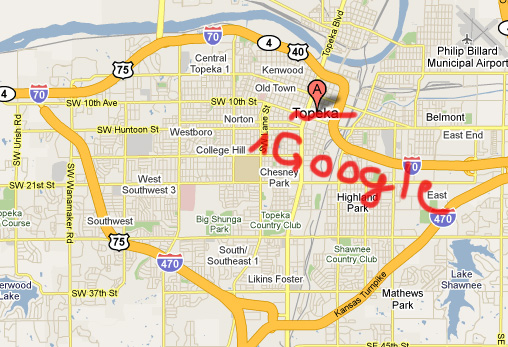
Google, Kansas

Over at my Kevin in the Kan blog, I've been writing about my hometown's efforts to woo Google to select it as a test site for its high-speed fiber optic network (which would bring surfing speeds of 100x faster than what most people have now).

I thought I would mention it here too because of how viral this grassroots effort has become. It is really a grand lesson in the power of social media and word of mouth (and how a community can work together WITH its government toward a common goal).

The latest PR move is when the mayor proclaimed that during the month of March, Topeka shall hereby be known as Google, Kansas. A silly move to attract Google's attention? Perhaps. That's what some are saying, but it's getting noticed! Here is some of the press attention Topeka (err...Google) has picked up:

CNBC
Wall Street Journal
BusinessWeek 
CNN (I like this one a lot...good job Mayor Bunten)
Christian Science Monitor
San Jose Mercury
The Week
The Register (UK)
Seattle Post-Intelligencer
San Francisco Business Times
Washington Post
Computerworld/Networkworld
Kansas City Star
CNET
National Post
Associated Press
Examiner.com
Barron's
Connected Planet
Newser
Los Angeles Times
Digital Trends
VentureBeat
TMCnet
NBC Bay Area
TechCrunch
PC World
 

The local effort has been pretty much exclusively through Facebook and other social media, plus local get-togethers. Check out the ThinkBigTopeka site for more info on the campaign.

Friday, February 26, 2010

Funny video

Enjoy this video of a dialogue between a hapless PR fellow and a blogger who covers social media, just not B2B. So funny.


If you're offended by the F-word, it is used frequently. I stopped using it as part of my day-to-day vocabulary when I was 17, and don't normally like to hear it in a professional setting especially. But, ok, it's kind of funny in this case.

Wednesday, February 24, 2010

Increasing Twitter Followers

When it comes to social media, everything has its place:

Facebook is MOSTLY for my personal friends, acquaintances, and a bunch of people that I know somewhat. In retrospect, I wish I would have limited it only to people that I really know, instead of the 450+ people that I'm sure I've met at some point.

LinkedIn is where I prefer to network professionally, and I have this blog connected to it so that anyone following me on LinkedIn can easily see my thoughts on any given day. I've joined a number of business groups on LinkedIn and have made some good connections there.

Twitter is the odd one I was never sure what to do with. I'm not one of those who wants to tweet when I go to the bathroom or have a bologna sandwich, or how cool so-and-so was on such-and-such awards show last night. I pretty much use it to tweet about successful media placements for my PR clients so that more people can discover how awesome they are, and of course that will hopefully make me look like a good PR guy that others will want to use. In order for that approach to be a success, I need followers!

To increase the number of followers, I've been finding people who tweet about topics I tweet about -- mobile technology -- and begin following them. I often get followed back, and people discover me on those Twitter pages and begin following me because they too like learning about mobile apps.

I have heard that around 30% of the people you follow will follow you back.

I just downloaded something new to help me greatly expand my number of followers. It's called Twitter Adder, and it is supposed to help me manage Twitter followers, auto follow, and auto unfollow. I'll let you know how it goes!

Tuesday, February 16, 2010

Doesn't Google Buzz just sound like a great PR thing?

I signed up for Google Buzz -- because what PR guy doesn't like anything that has the word "buzz" in it.

Buzz turns my Gmail into another social networking opportunity. Woo hoo! Just what I needed. Here it is in a nutshell:

* Automatic friends lists (friends are added automatically who you have emailed on Gmail)
* "Rich fast sharing" combines sources like Picasa and Twitter into a single feed, and it includes full-sized photo browsing
* Public and private sharing (swap between family and friends)
* Inbox integration (instead of emailing you with updates, like Facebook might, Buzz features emails that update dynamically with all Buzz thread content, like the photo viewer we mentioned above)
* "Recommended Buzz" puts friend-of-friend content into your stream, even if you're not acquainted. Recommendations learn over time with your feedback.

But, much to Google's chagrine, the "buzz" has been mostly bad. I've heard from several of my friends who have nixed it after a brief trial run.

This article highlights some of the most notable negatives:

Buzz seemed to have a mind of its own, picking names in your email inbox , and selecting them randomly for you to follow in your "Buzz" network.

"Thanks Google Buzz, I'm automatically following 3 ex-girlfriends. #fail," wrote Tony Pitluga of Pittsburgh in a tweet that was widely re-tweeted last week.

Another problem users discovered is that Google makes public everything you do in Buzz in its search engine, unless you set the privacy settings ahead of time.


Can Buzz bounce back? Google announced some improvements and should get credit for reacting quickly -- but as for me, I'll turn it off. I have Facebook, LinkedIn and Twitter, and that's enough social networking for me. Why add one more?

Monday, February 15, 2010

Don't be a pain in the Wave

I've been looking at Google Wave as a PR tool. Wave was introduced last year as a way to streamline communications into a single "wave" - it streams email, instant messaging, wikis, web chat, social networking, and project management into one platform.

What can you do on a wave? Your friends or colleagues can hold discussions, share files, chat, or comment on any of your post on any forum.

For PR pros, Wave changes the game. Anybody can contribute to the story with links, wikis, pictures, etc. BuzzMachine summarized it nicely here: "It combines the notions of a process as people add and subtract and update; it has the benefit of a wiki – a snapshot of current knowledge; it can be live; it can feed a blog page with the latest; it can feed Twitter with updates; it is itself the collaborative tool that lets participants question each other."

What I like is that Wave may return PR agents to communication agents versus just emailers of information. They can employ creative and engaging communication with anyone who joins the wave to get the word out about company news.

So leave it to PR people to already start getting a bad rap with a new technology tool. In my research, I found Jennifer Leggio's post highlighting some low-lights of how PR people have been violating the rules of engagement via social media:

1. Adding a journalist / blogger on Facebook and entering into a trusted network only to blatantly pitch said journalist / blogger on his or her “wall”
2. Spam @ messaging a journalist / blogger on Twitter multiple times to get them to review / write about your news or technology
3. Commenting on unrelated FriendFeed posts to try and get the writer’s attention

In a related post, Jason Perlow noted an early violation of Wave "PR Protocol" (if there's not such a thing, there soon will be). A pomegranate juice company I'd never heard of added him to their Wave -- you're not opted in, you're forced in.

Jason said: "As if using and trying to get used to Google Wave was bad enough, the PR agencies and marketing firms of the world have decided to start taking advantage of us, because we’re a captive audience and if they’ve ever contacted us in the past via e-mail on GMail, they now have a full contact database of people to torture by Google Wave if they were able to get an invite onto the system."

PR friends, Google Wave has a lot of potential for us, but let's respect the space of those influencers we want to connect with. Let's not be a pain in the wave and enlarge the credibility chasm our industry has with many in the media.

Saturday, February 13, 2010

I'm back

Wow...I really ignored the Winning Rules blog didn't I? Since I last posted, I published 2 more years of TK Magazine and just recently divested myself from the magazine publishing business. I still own and operate The Business Center, which is Topeka's executive suites and virtual officing center.

But my true loves and main interests (in biz anyway) are still TalonPR and Talon Communications Group; the former offers public relations and social media support for mobile software developers while the latter offers graphic design, web marketing and public relations for any kind of business or non-profit.

I've been doing my personal blogging over at KevinintheKan.com, where I dump whatever random thoughts that cross my mind on the ills of our country and my state.

Back to WinningRules, though, I want to return to highlighting the "Winning Rules" and best practices of Web communications and marketing. There's already good blogs out there that cover it, of course, but hey, this is what I know so hopefully you'll find practical info here you can use in your own business.

Subscribe to this feed and please share your own thoughts.

Wednesday, July 18, 2007

Breaking News Backstab

Jonathan Zaleski, the director of The PR Collective, a nationwide consortium of boutique PR agencies (to which I belong) has started a new blog called SpinisIn. It's all about the "PR lifestyle."

I particularly enjoyed his entry entitled the Breaking News Backstab, about the times in which his big PR events were eradicated by breaking news stories, such as the Pope dying right before his big event at Dodger stadium. Give it a read and enjoy.

Wednesday, July 11, 2007

How corporations should deal with blogs

Recalling the story of how Sony blew it with bloggers when one such blogger discovered secretly installed Sony software on his PC (and then discovered that it was transmitting his music selections to Sony over the internet), this OpinionJournal column gives some pointers for how corporations should deal with bloggers.

Monday, July 09, 2007

Firing bad customers

We know about the cost of obtaining good customers, but what about the cost of keeping bad ones? Sometimes the best thing for business is (perish the thought!) firing customers that cost you more than they're worth. Awhile back I heard about how FedEx would send notices to costly customers that they were no longer going to be doing business with them, and (going one step further) pointed them to the nearest UPS store location. So they got rid of people who were drains on their business and dumped them on the competition. Brilliant!

Today I read in ComputerWorld where Sprint is firing customers.

Thursday, February 08, 2007

The First Wiki Novel

From ComputingUnplugged:

Publisher launches Wiki novel
British publisher Penguin has launched a Web-based, collaborative novel that can be written, edited or read by anyone, anywhere thanks to "wiki" software, the technology behind Web encyclopedia Wikipedia. The novel, "A Million Penguins," went live on Thursday and its first lines are already being written, edited and rewritten by enthusiasts. Penguin, which embarked on the project with a group of creative writing and new media students, says it is using the novel as a test of whether a group of disparate and diverse people can create a "believable fictional voice."
What is a wiki? According to TechTarget.com:

A wiki (sometimes spelled "Wiki") is a server program that allows users to collaborate in forming the content of a Web site. With a wiki, any user can edit the site content, including other users' contributions, using a regular Web browser. Basically, a wiki Web site operates on a principle of collaborative trust.
The best known wiki is Wikipedia.org, an online encyclopedia in which anyone can contribute or edit content.

The idea of publishing a story with a wiki is certainly novel (sorry, couldn't resist). It will be interesting to watch how the story changes as the contributors create plot twists. Is that a story destined to go nowhere because a huge committee is involved in writing it?

Wikis hold great promise for practical business applications, from collaborating on projects to developing policy and procedure manuals to enabling users of a technology product have some control and input into the formation of a users guide.

Thursday, February 01, 2007

The second rule of kayaking

As a kayaker, this ditty that I received from Merge Gupta-Sunderji caught my attention. It's also makes a great point about good communication:

The second rule of ocean kayaking

Just a couple of months ago, I went ocean kayaking for the very first time. Not only was the experience thrilling, but I got an unexpected lesson in the importance of communication.

As my husband and I climbed into our two-person kayak, the instructor gave us the simple instructions. "Just two rules," he said. "Get a rhythm going, and verbalize your intentions to your partner at all times." "Piece of cake," I thought as I climbed into the front seat. And I was right, until we stopped for a snorkeling break a couple of miles from shore. My spouse, with the best of intentions, turned around to grab my snorkeling pack from behind him. Except ... he didn’t tell me what he was planning to do! If you’ve ever kayaked, you know what happened next. One moment I was staring at the blue sky, and the next moment I was treading water and looking at the underside of orange polyethylene. When the kayak tipped, everything -- people, snorkeling gear, sunscreen and sunglasses -- was now in the ocean. I spluttered my way to the top. "You’re supposed to communicate your intentions," I reproached my husband. "I thought you knew," came his chagrined answer.

Do you sometimes assume that people can read your mind? That your employees know what results you expect of them, that your co-workers will meet your unstated deadlines, that your supervisor will magically understand why you had to leave early? Whether it’s your employees, your co-workers, or even your significant other, don’t get so caught up in the rhythm of what works well that you forget to communicate your plans and rationales. Instead, remember the second rule of ocean kayaking: verbalize your intentions.

Merge Gupta-Sunderji helps turn managers into leaders. Through engaging keynotes and workshops, she gives people specific and practical tools to achieve leadership and communication success. Contact her at www.mergespeaks.com or 403-605-4756. I saw her speak at a IABC conference. She's very engaging and informative...so much so that I actually signed up for an e-newsletter (something I typically avoid).

Tuesday, January 02, 2007

Game du Jour

Ah...the Internet. Filled with great information and tools to increase our productivity, right? No, it is the biggest productivity killer ever invented--but it's so darn wonderful we can't get enough of it.

One of the biggest time killers of the Internet is searching the world wide web for "bargains." You pit our desire for a good deal with our penchant for friendly competition, and you get massive successes like eBay. First there was auction sites, and then later came "one deal a day" sites such as Woot.com.

For most "one deal a day" sites, you are in a rush to get in on the deal before supplies run out. There's a new one that will really kill your time--and supplies are unlimited.

Game du Jour offers one heavily discounted casual PC game per day. It starts at midnight and the deal lasts for 24 hours and then a new game is available. If you are into "casual games" and not necessarily the action-packed assassination and warfare games, this is a great site for you.

So what does this have to do with our favorite topic? Essentially, Game du Jour is a marketing company that helps software companies get a rush of sales of their product and increase brand awareness. They introduce your game to people that might not otherwise know about it. Considering how enormous the game development sector is, this kind of publicity can help to really boost awareness of that product and get gamers interested in the rest of your line.

Study: 2 of 5 bosses don't keep word

The Office is a great show. I think it's just so funny because the boss is such a doofus...and yet many of us can relate to his character because of bosses we either have or have had.

Now there's a study that shows the impact of bosses truthfulness and its impact on those they supervise. "Nearly two of five bosses don't keep their word and more than a fourth bad mouth those they supervise to co-workers."

The result of bad managers are poor morale, bad communication, a rumor mill, a revolving door of incoming and outgoing personnel, etc.

Wednesday, December 20, 2006

Will it Blend? Great viral marketing

Looking for another time waster on the Internet (other than this blog)?

Go have some fun at WillitBlend.com. The PR geniuses at Blendtec have produced a series of videos in which they blend a variety of everyday household items and answer the question I'm sure we've all asked ourselves: Will it blend?

Check out the iPod! And, in time for Christmas, see what happens when he tries to blend a couple Nutrackers!

This site is great fun...and a good example of how a business came up with a viral marketing approach that draws attention to their website, gets people to talk about it (like I'm doing now), and shows off the features of their product. Very, very savvy!

Now excuse me while I go buy a Blendtec blender!

Saturday, November 25, 2006

Five Best Books on Public Relations

OpinionJournal published Michael Kempner's list of five best PR books:

1. "Propaganda" by Edward Bernays (Liveright, 1928).

2. "American Hero" by Larry Beinhart (Pantheon, 1993).

3. "The Eloquent President" by Ronald C. White Jr. (Random House, 2005).

4. "Thank You for Smoking" by Christopher Buckley (Random House, 1994).

5. "All's Fair" by Mary Matalin and James Carville (Random House, 1994).

Other than "Propaganda," authored by the father of the public relations industry, the rest of the list are surprises. These are not your typical PR text books, and I'd never even heard of "The Eloquent President," a book about the eloquence of Abraham Lincoln. I'm a big Lincoln fan, so I don't know how I missed it, but I'm off to BN.com to pick it up.

Regarding "All's Fair," this is a terrific read. I'm proud to own a signed copy--signed by BOTH Matalin and Carville. They were the keynote speakers at the IABC conference in Washington DC in '95. If you haven't read it yet, go get it. It's fun for political junkies (like me) and PR pros (also like me). Enjoy!

Thursday, November 16, 2006

PDA Users Suffer from Email Overload

I love my Palm Treo, but do I think it makes me more productive? No. Isn't it SUPPOSED to make me more productive? Yes!

Well, a study put on by my beloved International Association of Business Communicators (IABC) found that 85% of the 1,700 business communication professionals interviewed had productivity issues thanks to email.

Sixty-two percent of respondents to the IABC survey said they receivetoo much e-mail, compared to 75 percent of PDA users. In addition, almosthalf of the respondents (44 percent) agreed that they send too much e-mail. In comparison, 56 percent of PDA users are guilty of sending too much e-mail.

I'm not sure that my Treo's email capability is what hurts my productivity...it's just always being available (as with any cell phone), and having it loaded with games that are too fun to pass up when I have some time to kill (ok, time that I COULD spend doing something more productive).

Oh well...productivity is highly overrated.

Wednesday, November 08, 2006

What Abe Lincoln can teach us about email

Telecom expert Tom Wheeler says that Abraham Lincoln, the first U.S. president with access to the telegraph, developed a personal code of electronic communications that modern-day netizens would do well to adopt in their email habits.

Wheeler describes Lincoln's "T-mail" etiquette and the lessons we can learn from it, like:
Less is More - Whereas many saw the blank telegraph form as an invitation to an essay, Lincoln's telegrams were short and to the point. "Your long despatch of yesterday just received," Lincoln chided General George McClellan about a 10-page telegram sent in May 1863. Then the president required only three additional sentences to reply to the general's endless essay.

Responding to a long-winded message with only a few words is indeed a great way to train others how to use email.

Read about it here:

What Abraham Lincoln Taught Me about Email

Saturday, October 28, 2006

RSS is killing blogging

From ComputingUnplugged:

RSS is killing bloggingBefore RSS, Web surfers could just browse and google for news, opinions, and hacks. Since RSS feed readers became popular, only the highest volume blogs get personal syndication. Small bloggers are getting no RSS Traffic and minimal browsing traffic. RSS is killing bloggers, so bloggers ask, what can be done for us underdogs?"

Jason Calacanis of AOL and Engadget.com once stated that a secret of successful blogging is "fresh and frequent blog postings." So readers subscribe to only the most frequently updated and well known blogs RSS feeds leaving for-the-love-of-journalism-bloggers "under the syndication radar." Simply due to low posting volume, the vast majority of key bloggers get little to no readership. The founders of ZNITCH.com made it their mission to level the playing field and expose non-celebrity bloggers using what they call, "the opposite of RSS."

Monday, October 16, 2006

Mobile Etiquette

One of my favorite mobile tech analysts is Gerry Purdy, now with Frost and Sullivan. Here are his tips on the new social etiquette required because of public use of mobile technologies:

Social Etiquette in Mobile

New mobile technologies create wonderful new capabilities, but they also create the need for new social dynamics. The most obvious benefit is the ability to make or receive a call wherever you are. This can be a lifesaver when you’ve arrived at the airport on a flight and want to know where your ride is. It reduces anxiety, and the person picking you up is relieved to know that you’ve arrived. All is good.

Now, take that same capability and put yourself in a restaurant or another quiet place, such as a church. Someone is trying to reach you, and the phone goes off and makes a loud noise. You’re embarrassed and others near you are bothered. The person calling doesn’t know that you’re in a quiet place, and it just deteriorates into a bad situation. Thus, new mobile technologies create new services that really benefit users, but they also create the requirement for a new “mobile etiquette” that we must develop so that the capabilities are utilized, but are only done so in the right social rules of etiquette.

Let’s review that restaurant situation again. Someone needs to reach you. It could be a nurse desperately needing to reach a doctor about a patient. Or it could be a family member that’s trying to reach you about an important matter. You know that it’s impolite to have your cell phone ring in quiet places, so you put your phone on vibrate mode. The person calling doesn’t know if you can talk or not, so they know that it’s best to send you an SMS text message asking if it’s OK to talk. You feel the phone vibrate, look at the screen, and text back that you’ll step outside so you can talk. Thus, using “mobile etiquette,” everyone’s needs are met and the new “must reach you now” capability is still able to be used.

Now, take a different situation that involves data. Often, it’s just not socially acceptable to bring your notebook PC into a meeting. The screen creates a barrier between you and the others in the meeting. You are clearly doing email while others are talking. What do you do in this situation? Pray of course! You walk into the meeting with your BlackBerry, Palm Treo, Nokia e61, Motorola Q, or other similar device. You feel the phone vibrate and notice that you received an important email. You hold the phone under the table and pretend to “pray” while you “thumb” your reply. The same is true for SMS messages. As a result, some important topic can be addressed without bothering anyone in a meeting.

Just like with any other technologic advance, things taken to extreme are not positive. For example, if you tried to answer 40-50 email messages while you were in a meeting, others would know what you were doing and feel that the slight diversion to address something important had been violated by your not participating in the meeting.There are some times that you need to turn your cell phone off or not even look at the display if you feel it vibrating in your pocket. Every situation is different, and you have to adapt the new technology to the surrounding social setting.

There is a new network infrastructure under development, called IP Multimedia Subsystem (IMS), that will help most of us handle difficult social situations. IMS will provide “presence” and interactive messaging so that you can see if the person you’re calling is available to take a call or not. That alone will be a tremendous advance in the use of mobile phones.

My recommendation is simple: honor people’s privacy and use mobile technologies in ways that are socially acceptable. I’m glad that we have created wonderful new communications capabilities with cell phones, but a responsibility goes along with those capabilities, and that is to use them in a manner that is acceptable to most social situations.

Tuesday, September 26, 2006

Journalists surveyed on effective PR contact

From the Publicity Insider (www.publicityinsider.com):


Unless you work in a newsroom every day, it is hard to gauge reporters' likes and dislikes when working with publicity seekers.

Thanks to public relations firm Bennett & Company's annual surveys, we can take the media's pulse. Here's some findings from their Annual Media Survey:
  • Email: Fifty-eight percent of all journalists surveyed preferred email as the main way to receive information, followed by wire service (15%), regular mail (13%), fax (10%), and telephone (4%).
  • In addition, 70 percent of journalists said that they read every e-mail they receive except for obvious spam. Bill's Note: Keep in mind these results are the media's preferences - not what gets the best results for the publicity seeker. When appropriate, the telephone's human connection is still a publicists' best friend.
  • Personalized Address: Fifty percent of the media polled said they respond more readily to a personalized address and 4 percent said that a general editor address will do. The remaining 46 percent did not have a preference. Many noted that while they do not have a preference, personalized communications reach them quicker.
  • Availability of Multimedia: Fifty-nine percent of media polled said that the availability of multimedia (photos, charts, graphs, audio and video) does enhance the chances of a story being used.
  • How important are weekend, night and cell numbers for contacts on news releases? Back in 1990, 44 percent of journalists said they were not necessary. Currently, 72 percent deem full contact info important.

Wednesday, September 13, 2006

CTIA Day II

Had a few good meetings today... I really like Audible.com--though I remember that they were the ones that got slammed by the keynote speaker at a PalmSource Developer's Conference for their awful website. You can use Audible to put your podcasts, audio newscasts or audiobooks on your Java, Palm, Symbian, or Windows Mobile device. The company makes it very easy for you to have your favorite content downloaded to your device in minutes and purge your system of old content. Very cool.

Macroport is pretty cool. www.macro-port.com. They allow you to put content on a storage card, and the software on the card identifies what kind of device it has been inserted into and then automatically launches your content in the proper format. Users usually don't know what kind of operating system they have on their device, so this makes it irrelevant. If you publish content--examples I saw were promos of video games and trailers for upcoming movies--this eliminates the stupid factor when dealing mobile content.

JuiceCaster is one of my favorite things I've seen here so far. Juice Wireless now allows you to publish your pictures, text, videos to whatever website you have that enables HTML publishing. Then you can share it with a select group of people or with the public as a whole. The demo I saw was a video they took with their cellphone, uploaded to the juice account, then downloaded on another mobile device to be viewed, then also available on a personal blog. There are so many potential applications for this, but just for personal use it's a great way to share pics and videos with family and friends scattered all over the world. They say that JuiceCaster "connects the user's cell phone to their entire online life." See it at www.juicecaster.com. I dig it.

More to come later. I need to get to the airport.

Tuesday, September 12, 2006

CTIA news

Today was my first full day at CTIA and it's been a fun rush of meetings...mostly with people I know, but I also took the time to check out a press conference and look for the smaller "what's new" people. Amazingly enough, according to their press releases they are all the "leaders" in their industries. Never heard of them, but I digress.

This one is pretty cool, actually. A London-based company called Mobix announced peer-to-peer mobile video sharing called "Shoot 'n' Share" in which you can send videos to your friends from your mobile phone. You can send them to another phone, an email address, or a website, or you can send them to a cell phone from your online video storage website.

www.mobixinteractive.com

Bango has signed a mobile search marketing agreement with Yahoo!, and "will offer Yahoo search advertising products and services to mobile content providers, through the integration of Bango's platform and Yahoo's mobile marketing service. This also creates a one-stop solution that allows businesses to establish a mobile presence and billing capability, then create mobile search advertising campaigns on Yahoo to target users who are looking for products and services through their mobile devices."

www.bango.com

My favorite subject: taxes! Keep your filthy taxes off my wireless (and my Internet while you're at it). MyWireless.org launched a new ad campaign to shine a light on how state and local taxes and regulations "threaten to pull apart" the nation's successful wireless framework.

www.mywireless.org

Wednesday, September 06, 2006

CTIA IT Wireless & Entertainment

I'll be traveling to CTIA next week in LA and will be blogging from the event. I'll report on social networking, mobile marketing and electronic communications that is cool and noteworthy--the greatest cutting edge stuff I've ever seen I'm sure.

I'll also have a photo SplashBlog set up so you can see pics as I'm moving around the show.

I've got great meetings set up and I'm excited about the stuff I'm going to see there.

Friday, September 01, 2006

Radio Shack fires off an email

Well, another big case of the impersonal termination of employees via electronic means. Radio Shack sacked 400+ workers and alerted the immediately displaced workers via email. I wonder if the email message was colored pink?

I don't care if you personally alert people in advance that they may lose their jobs, and if they do it will be electronically, that doesn't make it an acceptable approach. It may not be personal to you (yeah, it's just business, got it), but it's personal to them. These are people who dedicate themselves personally to their job with your company and you owe it to each and every one for a supervisor at some level to personally be the bearer of bad news.

Thursday, August 31, 2006

"Google" is NOT a Verb (lest ye be sued into oblivion)

The lawyers for Google have something to earn a few fee dollars on now. I just saw a tidbit in Tidbits about how these wiley lawyers are all bunched up about the word "Google" being listed as a verb in the latest edition of Websters and have been sending out terse notes to media organizations that they had better not use the word as a verb.

This is the problem with being too successful and establishing your brand as a universal word for something like web-searching.

Poor Google...getting their company name in the dictionary. How sad for them.

Thursday, August 10, 2006

Firing someone by Texting them

I love text messages, especially since they're so easy to fire off with my Treo. "Fire off?" What an ironic choice of words considering the story I just read:

U r sckd: worker fired by text message

No matter how awful it is to can someone to their face (trust me, I know), let's not get so impersonal that firing someone with a text message ever becomes acceptable.

Saturday, July 15, 2006

Blog Ads

If you're interested in making money from your blog, you might want to read this bloggers' guide to advertising revenue for bloggers.

Is it true that bloggers don't like to make money? How provocative! I guess you'll need to read their paper to find out if it's true!

Bigg results with Digg hits

Here's an interesting post on Cybernet on the impact that a front page hit on Digg will have on your web traffic and RSS subscriptions.

Digg is a "user driven social content website." I've posted about it before, and I love it. Users pick the stories THEY think are important and "digg" them. The stories with the most diggs gets ranked the highest on the site.

My.yahoo also ranks stories, but according to the most popular (those that get the most click-throughs). I like the Digg model better, because just because I click on a headline doesn't mean I value the story. Once I get to the story, it may not live up to the headline and I wouldn't recommend others clicking into it like I did. Digg lets me tell others that I think the story is worth their time. And I digg it!

Sunday, July 09, 2006

TK Magazine whirlwind

It's been a crazy week and a half, and the whirlwind will continue this week.

See pictures of the TK Magazine launch party here.

We had nice press coverage by 13 and 27...you'll see pics of us being interviewed. Thanks so much to those stations, especially 27 and Nate Hill in particular for broadcasting live from our event.

On July 6th, we "made history" by presenting the first issue of TK Magazine to the Kansas Historical Society & Library. I'm a history buff, and one of the thrills of making a local magazine like TK is becoming a part of the historical record. Kansas history, in particular, is a hobby of mine. It's so colorful. Few states can boast of the rich history of Kansas--full of treasure seekers, trails (before we were flyover country, we were wagon-through country), gunfighters, and the whole 'bloody Kansas' thing that really got the Civil War going. Now, with a full color magazine for Topeka, our history of today can be recorded (literally) much more colorfully.

This week we are prepping for a big live broadcast with Majic 107.7 downtown. Our "TK Girls" will be downtown passing out free magazines while Lola's Cafe sells sandwiches and drinks for $1.07. This will happen on Wednesday. Hopefully we'll see you there.

I'll be getting back to posting about communications technologies and the like very soon.

Thursday, June 29, 2006

TK Magazine

We are 1 day away from the launch of TK Magazine! Our launch party is tomorrow night at Jul's. Our goal with TK is to provide Topeka with a classy magazine that showcases the business in the local business and lifestyle scene.

Our big unveiling of the cover (and we have a BIG cover printed up) will be at 6:45 p.m.

Go to the site and subscribe to our RSS feed so you can always get the latest business and community news.

Wednesday, June 21, 2006

Regulating the blogs

Could the end of free blogging be near? Read this column.

The Internet is the newest and most free medium of communication, which can be used to check both government and the mainstream media. This means, of course, that the government is already looking to regulate it. If certain legislators have their way, the end of free blogging on the Internet will come sooner rather than later.

Tuesday, June 20, 2006

Better podcasting

Yeah, yeah...it's been awhile since I've posted to the blog. I'm sure you're all dying out there.

A little magazine project kind of took over my life. See www.tkmagazine.com. It's a new lifestyle and business magazine for Topeka. I'll tell you more about it later.

But for now, here's a great piece on what makes a great podcast. I love podcasts...especially now that I received an iPod from my kids (read: my wife). Podcasts give you a great opportunity to connect with an audience on a personal level and communicate with audible learners. Oddly enough...that's not me. I remember more from what I read, but I still enjoy listening to very good podcasts (though I often couldn't tell you at the conclusion what it was about--funny how the brain works so differently).

Monday, June 05, 2006

Getting Fired for Email Abuse or Using Surveys for Big PR

Here's a CNN story on how a third of companies surveyed have fired someone for violating email policy.

Proofpoint reported that employers are ever more concerned that outgoing e-mail could pose a risk to the company. As a result, many companies are hiring staff to read and analyze outbound e-mail. According to the study, 44 percent of major U.S. companies have hired employees to do so.

Blogs and Instant Messaging are also a concern to many employers. Seven percent reported that an employee was terminated for such a violation while 17 percent reported that an employee has been disciplined.

This is interesting, and something companies should think about. Do you have an email policy?

But, to me, the more interesting thing is that Proofpoint, a company that helps companies reduce email risks, used this survey that they sponsored to get big press coverage (a CNN story!) for their company! And surveys can be a very inexpensive way to create a story

Sunday, June 04, 2006

PR rules for dealing with bloggers

Different strokes for different folks, and that includes bloggers. Some will take any and all contact from PR people, some want contact only under specific conditions, while others don't want to hear from you at all.

Go here to read an interesting idea from Mobhappy on how PR pros can recognize the preferences of the blogger.

For the record, here is Mobhappy's own "policy":

1. Please make sure that the information is about mobile technology, or at a stretch, technology generally. Read the blog - is there a good chance we might publish it?
2. If you keep sending us rubbish, we won't read your pitches any more.
3. Keep it brief please, in the first instance. We can always ask for more info.
4. Don't use the comments section on our blogs to blatantly promote your or your client's products. It REALLY pisses us off. You have been warned.

Here is a blog post from awhile back that used ME, of all people, as an example of how to pitch to bloggers. It's amazing how many people who I know saw this post.

Friday, May 26, 2006

Search Engine Optimization

Here are some nice tips on getting search engines to find your web site, thanks to Amy Campbell:

1. Use keyword-savvy "page titles," and strategic and proper metatagging on all pages.

2. Allow search-engine robots easy access throughout your site via text links, alt-tagged navigation icons, or a site map.

3. Register your URL with major search engines, directories and specialty sites, as well as select paid directories (such as Yahoo!).

4. Use strategic home page content (keywords in context in HTML text).

5. Use hyperlinks to further weight in-text keywords.

6. Encourage in-bound links from other relevant sites to your pages.

7. Add an integrated web log to your web site.

8. Add/update content frequently. (Write dammit!)

9. Avoid Flash-based opening home-page screens, improper metatag code, as well as any schemes meant to "trick" search engines.

10. Get a search-engine optimization audit for your web site.

Build a Better Blog

I've got a link for anyone wanting to build a better blog. Why does your blog stink? Good question...here's a blog with good answers:

www.whymyblogstinks.com

It's a fairly new blog, but includes insightful tips on improving the smell of a stinky blog.

Tuesday, May 02, 2006

Mobile Marketing

I love gadgets. I love marketing. You would think I'd be the ultimate expert on mobile marketing! I really need to get into it.

Here's a nice article on it.

Excerpt:
Mobile marketing should encompass more than just building brand awareness. It needs to be a robust part of the overall marketing strategy, helping companies to not only manage their overall brand message, but also to improve customer relationships, educate customers about products and solutions, and essentially give the company even greater control over its sales funnel.

Saturday, April 29, 2006

Blogging and search engines

It's no doubt that adding a blog to your business site is good for business--creating open lines of dialogue between you and your customers, especially when needing to generate buzz prior to a product launch, just makes sense.

A blog is also good for search engines. Not just good--terrific! Search engines love blogs!

If you want in-bound traffic from search engines to your site, you couldn't ask for a better way to achieve your goal than by adding a blog. Why?

  • Search engines favor relevant content, and blogs that are regularly updated with keywords commonly searched by surfers are ripe for the picking. If your blog is updated frequently and on a common theme or topic, it will find favor with the search engines.
  • Search engines like sites with incoming links--and links are what brings blogs alive and connects them to related content. Search engines give extra weight to links from sites focused on the same topic. Referrals from other blogs add credibility for your own blog in the eyes of the search engines.

There are plenty of reasons to start a business blog, and search engines are one of the best ones.

Sunday, April 23, 2006

The Story Behind Digg

Don't be a Johnny-come-lately when it comes to knowing about Digg and it's democratic approach to news. There WILL be imitators and anyone in PR and business communicators will need to know about it.

Here's the story.

Saturday, April 22, 2006

Hold the press (releases)

TechCrunch blogger Michael Arrington spoke about likes and dislikes from PR folk. One stand-out suggestion: don't send him press releases. This is a common view from bloggers...they'd much rather have something quick, personal, and with good links.

Summary here.

Tuesday, April 18, 2006

Candor in Communication

Read this dandy column on how refreshing candor would be in political communication.

It certainly goes against the grain, as PR folk, to NOT put the best spin on every piece of communication; yet, people long for authenticity. They're almost starved for it in this age when no one admits fault or that they don't know the answer to the question being asked.

Perhaps a dose of candor would go a long way toward building credibility with your audience!

Wednesday, April 12, 2006

Podcasting, MP3 Players Stealing Radio's Audience

PodcastingNews reports:

Podcasting and MP3 players are stealing radio's audience, according to the latest figures from Bridge Ratings. According to Dave Van Dyke, President of Bridge Ratings, "By 2010, today's 94% penetration for terrestrial radio will have sunk to 85%."

27% of people 12-24 attribute their reduced use of radio to MP3 use; 22% attributed it to tired radio programming; 3% attributed it to podcast listening.

Thursday, March 30, 2006

New RSS Services

NewsGator has been busy! Here's the latest:

03-28 NewsGator Technologies, an RSS platform company, announced NewsGator Inbox 2.6. Previously known as NewsGator Outlook Edition, the new offering includes clippings synchronization with the NewsGator Online Web-based RSS aggregator, integration with FeedStation, NewsGator's podcatcher, and the ability to view Web pages while working offline.

03-28 NewsGator Technologies also announced FeedDemon 2.0. The new version of the company's desktop RSS aggregator for Windows adds seamless synchronization with the entire NewsGator Online platform, and improvements in usability and system performance.

Tuesday, March 21, 2006

Outted by Plaxo

Anybody who uses Plaxo to keep their Outlook Address Book up-to-date should be warned: you can blow the news of a job change or company acquisition simply by updating your own Address Book entry!

I know a guy whose company was acquired by another company. It was to remain a secret until a later date, but he went ahead and changed his contact information in his Address Book--and lo and behold pretty soon hundreds of his contacts received Plaxo updates that included his new title, employer and contact info.

Within hours, there were blog and news postings about the acquisition and they had to speed up plans for their announcement of the acquisition.

Monday, March 13, 2006

PR is Stale at Yale

Yale recently admitted a former top Taliban official as a student and refuses to answer questions about it. This is the same Yale that refuses to allow the establishment of an ROTC group on campus. Anti-military and pro-Taliban? On an American campus? Gosh!

From today's Opinion Journal:
"Yale is practicing a most unusual media strategy," says Merrie Spaeth, a public relations executive whose father and uncle went to Yale. "I'd call it 'Just say nothing.' " Another PR expert characterized Yale's strategy as "Trust that people will lose interest in the questions if there are no answers."

Pretending that your crisis will go unheralded and it will all go away if you simply don't answer questions is a guarantee that your crisis will be blown into bigger proportions than ever. Yale responded to the Wall Street Journal writer by saying it wouldn't respond. Perhaps the communications officer is a former member of the Bush Administration. Bush is, after all, a Yale alumni and heads an administration that famously makes poor use of proven communication strategies.

Here are some tips on crisis communications:

  • Before a crisis hits, you should have a crisis management team established, including key officers, a spokesperson, and a communications strategist (if not the spokesperson);
  • As soon as a crisis storm starts to brew, start pulling together the necessary facts (the who, what, where, when, why, and how);
    Be quick to share the information you think the media should have and will want to have;
    If they don't get the information from you, they'll get it from somewhere else--sometimes giving information is painful, but it's better coming from you than someone else;
    Don't shoot from the lip--if you don't have the answers, say you'll find out and get back to them;
  • During or after a crisis is a great time to demonstrate that your organization is a good civic citizen--do something good for the community;
  • Don't act like Yale.

Saturday, March 11, 2006

Speaking of speaking...

Yesterday I was the guest speaker to a Washburn University "senior seminar" class of Mass Media students. I spoke to them about lessons along the pathway of my career.

While I was talking about some of my key rules for managing your career, the big rule that I should have remembered was to bring bottled water with me. By the end of my 45 minute spiel I was so cotton-mouthed that I sounded like Harry Belafonte (without all of the ridiculous political statements, of course).

Wednesday, March 08, 2006

Can your CEO speak better than Jon Stewart at the Oscars?

I didn't watch much of the Oscars. It was a bad movie year--the ones I enjoyed weren't nominated for hardly anything and the ones that did likely won more for their appeal to the liberal glitterati of Hollywood than for their artistic merit. I've heard that Jon Stewart didn't go over well as host, which is somewhat surprising to me--but Bulldog Reporter has pulled out some lessons that PR practitioners can glean from his example:

  1. Don’t assume your client who speaks well in front of 20 people in his or her own conference room can make an instant transition to speaking in front of 100 people in a convention center.
  2. Don’t assume your client who speaks well in front of 100 people can make a smooth transition to speaking in front of 1000 at a trade conference.
  3. Help your clients get conformable with the size and sound of the room by rehearsing in the same room where they will be giving a speech.
  4. Any new technical equipment (e.g., wireless mics, TelePrompTers, lights) needs to be rehearsed with in advance—not used for the first time in front of a real audience.
  5. Help your clients build their confidence levels by exposing them to increasingly larger audiences—don’t make them jump from an audience of five to 500 in one presentation.
  6. Rehearse, rehearse, rehearse (and do it with video).

Tuesday, March 07, 2006

Measuring the Influential Experts on Business Blogging

Onalytica decided to measure influential experts on business blogging and makes some good points about the difference between popularity and influence:

When Technorati ranks blogs they count the number of link sources pointing to a blog. So a blog that has 10 inbound links has higher rank than one that has 5 inbound links. So far so good. The blog with inbound links from 10 different sources is clearly more popular than the one with 5 link sources. However, when they use this measure of popularity as “authority” they are stretching it too far. David Letterman may be popular when it comes to the topic of US national politics, but few would call him an authority on the topic.

Check out the findings at the end of the post. It may lead you to some very helpful information on the topic.

iSift

I've become a fan of Digg.com, where you have the opportunity to vote for stories that you "digg" and raise its ranking on the page. More popular articles get higher placement, and rather than being chosen by an all-powerful editor who uses his own subjective bias to determine ranking the big stories are the ones most popular with the readers.

Here's a new one: iSift. From their home page:
iSift.com is a community for publishing and rating Internet-related news and content. Submit content or vote for submissions that you think are interesting. You can also give a story a negative vote. iSift has been inspired by digg.com and del.icio.us but places a greater emphasis on independent news and content.

Friday, March 03, 2006

Does blogging help or hurt?

This Bulldog Reporter op-ed makes the case that blogging may not be all it's cracked up to be. He advises against jumping into the latest "craze" and, instead he advises "increasing investment in real advocacy education and civic debate in order to achieve goals." He says that blogs encourage people to only tune into messages that reinforce their currently held beliefs rather than exposing themselves to alternative viewpoints. This is valid because blogs that one visits are most commonly linked to other blogs that support the same viewpoint. But then again, so what?

Blogging is going to happen whether you "invest" in it or not. Who do you want to influence? In business, you want to invest in communications that targets most likely consumers. If you sell toilet paper, you're going to have an audience of just about anybody--but who wants to go to a blog about toilet paper and its uses anyway? Blogging is effective when it draws a crowd of people with specific interests and engages them in dialogue. Operating a blog and engaging those who operate blogs that target those with a common interest is smart business, and there are few communication tools out there that could do it more effectively than blogging.

Even if you're a politician or a civic organization, why not blog? I don't get the point of arguing against it. You want to energize your base with a blog and keep your natural constituency informed. Those on the other side will do the same. Those in the mushy middle will have blogs of their own and may visit blogs on the right or left. Blogs may spread false propaganda, like tabloids in the checkout lane, but they can also accomplish for you what the MSM won't. You don't have to look further than Rathergate to know that the blogosphere can hold the MSM accountable.

To me, it's all good.

Wednesday, March 01, 2006

The Voicemail Opportunity

My friend Cyndi Menzel, Communications Director of the Kansas National Education Association, doesn't waste an opportunity. Her email messages are always signed with the organization's tagline: "KNEA: Making Public Schools Great for Every Child." And her voicemail echoes the same message. She concludes her voicemail message with something along the lines of "We're busy making public schools great for every child."

I'm shocked at how many people waste the voicemail message opportunity. Not only do they blow it by not even using the name of their company, they fail to seize the chance to emphasize their brand message.

I cringe when I call someone on their work number and their voice mail says something like, "Hello, this is Bud. Leave a message and I'll call you back." Yuck!

Sad to say, many calls find your voicemail more than they find you. What is the experience you are offering your callers? If they have made it through voicemail hell to get to your extension, make it pleasant and your message to the point. Don't do the ordinary, lame message. It is not just your business brand, but your personal brand that is being wasted.

Here is a nice article on other ways to promote your personal brand.